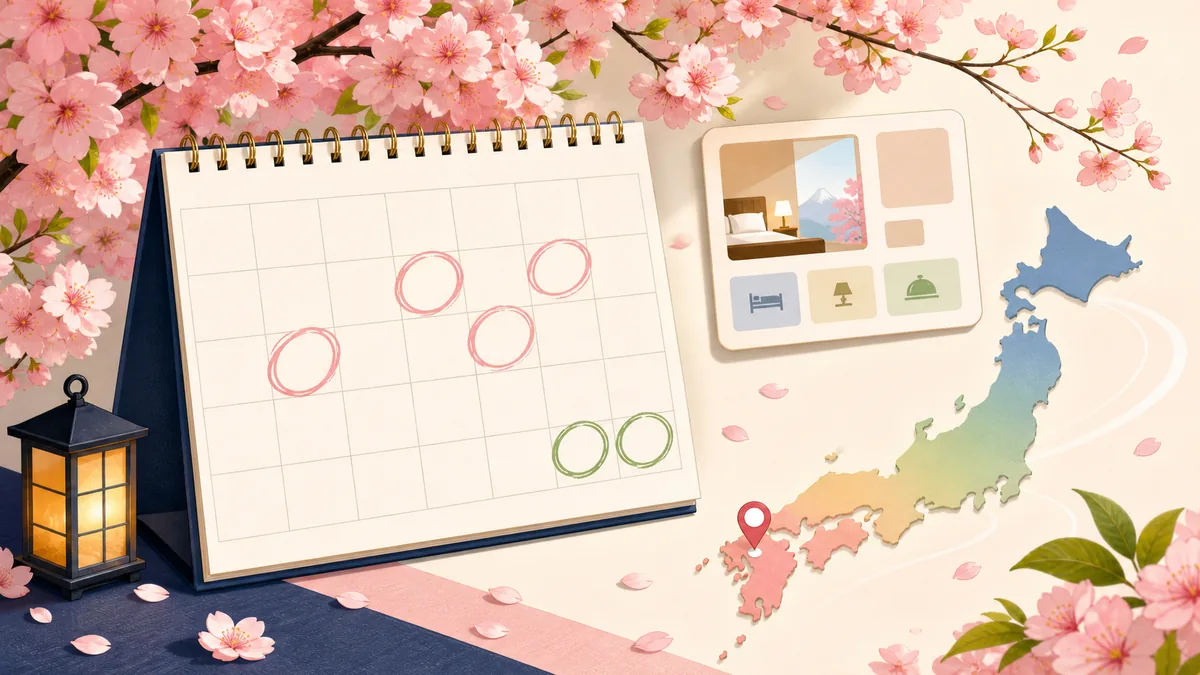
Every front desk has a week it dreads and a week it loves at the same time, and in Tokyo that week is sakura. I've worked enough overnight shifts through late March to know the pattern by heart: the phone rings more, the walk-ins get shorter tempers, and somewhere around 11 p.m. a guest asks if we can "just squeeze in one more night" because the blossoms weren't quite there yet when they arrived. Nobody can promise a guest peak bloom on a fixed date, and any site that implies otherwise is selling you a story. What follows is the booking strategy that actually holds up: when to lock a room, how prices and availability move as the date approaches, and how to build a Plan B so a slow bloom or an early one doesn't wreck the trip.
Why Sakura Season Breaks the Normal Booking Rules
Most travel demand spreads itself out. Sakura demand does not. The entire viewing window in a given city runs a week or two — nobody publishes an authoritative figure for how long petals stay on the tree, and it varies with wind and rain as much as with the calendar — and a huge share of travelers want to be there for exactly that stretch. That compresses months of ordinary demand into a fortnight or so, and it does it on a date nobody can fix months in advance, because the trees decide, not the calendar. From behind a desk, this shows up as properties filling from the highest room categories down, corporate and long-stay guests getting quietly bumped to slower months, and front desks fielding date-change requests almost daily once the first regional forecasts land. If you're planning around bloom, you are competing for inventory against everyone else who read the same forecast you did, at the same time you did.
How Bloom Forecasts Actually Work — and Why They Move
The forecasts you'll see quoted everywhere break into two dates: kaika, first flowering, and mankai, full bloom, which usually follows a week or so later. Both are estimates, built from tree observation data and temperature modeling, and both get revised repeatedly through the season as real weather comes in. A mild February can pull dates a week earlier; a cold snap in March can push them back just as easily. It is worth knowing who actually publishes what. The forecasts come from private weather companies — the Japan Meteorological Corporation and the Japan Weather Association are the two you will see quoted — and tourism bodies republish them rather than producing their own; the Japan National Tourism Organization's bloom table, for instance, carries the line "Source: Japan Weather Association." The Japan Meteorological Agency, the government forecaster, does something different again: it observes, declaring flowering when five or six blossoms have opened on a designated sample tree and full bloom when about 80 percent of the buds are open. As for timing, the first estimates land months ahead, not weeks — JMC published its opening forecast for the 2026 season on 18 December 2025 and its fourteenth and last on 23 April 2026, roughly one revision every week to ten days. Which tells you something important: even the professionals building forecasts full time don't commit to a single date until the trees are almost there. Treat any date you read in January or February as a rough compass heading, not a booking target.
A Realistic Booking Timeline
There isn't one magic day to book. There's a sequence of decisions, each with a different amount of certainty behind it.
| Time before travel | What's known | What to do |
|---|---|---|
| 6–9 months out | Nothing about this year's bloom timing | Book a refundable room for a window of dates around the historical average, not a single date |
| 3–4 months out | First long-range seasonal outlooks, still rough | Confirm your city and neighborhood choice; keep the refundable rate unless the price gap is large |
| 4–6 weeks out | First official kaika/mankai forecasts published | Compare your dates against the forecast; consider shifting a non-refundable booking if it's still allowed |
| 1–2 weeks out | Forecasts tighten to within a few days | Lock final dates; expect limited flexibility left in inventory |
| Under 1 week | Near-real-time flowering reports | Adjust day-trip and viewing-spot plans, not the whole itinerary — it's too late to rebook a hotel cheaply |
The guests who come through the calmest are the ones who booked early with flexibility built in, then made small adjustments as the forecast sharpened. The rough nights are the ones who booked late and non-refundable, betting on a single date holding.
What Price and Availability Actually Do
Rates in the sakura window don't rise smoothly — they step up as blocks of inventory close out. A property might hold a steady rate for months, then jump twice in the space of a week once regional forecasts narrow and everyone tries to lock dates at once. Weekends inside the peak window go first; weekday nights hold out a little longer. Cancellation behavior matters here too. When a forecast shifts and a chunk of refundable bookings cancel out of one date and pile onto another, you'll sometimes see a room reopen a few days before arrival at a price close to where it started. That's not a guarantee you can time it — I've seen it work for a guest once and fail for the next three who tried the same trick — but it explains why availability looks so erratic during this window instead of just climbing steadily.
Refundable vs. Non-Refundable: Read It Like You're the One Checking Guests In
Non-refundable rates during sakura season look tempting because the discount is real. Whether it is bigger than the rest of the year is something we cannot show you — no one publishes a season-by-season comparison of discount depth — so treat the gap on your own booking as the only number that matters. But the trade you're making is specific: you're accepting the calendar risk that the hotel would otherwise be pricing in. A few things worth checking before you commit to one:
- Whether the cancellation deadline is calculated in Japan Standard Time or your home time zone — this trips up more guests than you'd expect
- Whether a "date change" option exists separately from cancellation, since some non-refundable rates allow one free date shift within the same booking
- Whether the discount is large enough to be worth losing flexibility, or just a few percentage points that don't offset the risk
- Whether you can split the stay — refundable for the nights you're gambling on bloom, standard rate for nights where the itinerary doesn't depend on it
A guest who books non-refundable and gets lucky on timing feels smart. A guest who books non-refundable and gets an early bloom before they land is just out the money, and there's no complaint desk that fixes a tree that flowered on schedule.
Building In a Plan B: Dates and Regions
The single most useful thing you can do is stop treating "the trip" as one fixed date range tied to one city's bloom. A few Plan-B moves that front desks see work reasonably well:
- Widen the window. Book six or seven nights instead of three or four, spanning the range where forecasts historically land for your target city, rather than betting everything on the median date.
- Shift north or south. Bloom moves from south to north over about six weeks across Japan — in an average year Fukuoka and Kochi flower around March 22 and Sapporo around May 1. If Tokyo's window looks like it will close before your trip starts, an earlier southern city or a later northern one can still deliver blossoms on the same overall itinerary.
- Accept the shoulder days. The days just before full bloom and just after — while petals are still falling — are real viewing experiences, not consolation prizes, and they're markedly easier to book.
- Diversify the itinerary. Build in destinations and activities that don't depend on bloom timing at all, so a miss on the trees doesn't mean a miss on the trip.
How you pick a base city and neighborhood affects how much of this flexibility you actually have. For the general logic of choosing where to stay in the city, see our guide to where to stay in Tokyo, and for how proximity to a station changes your options night to night, see choosing a hotel by train line.
The One Booking That Deserves Its Own Plan: Yoshino
Mount Yoshino in Nara is a special case, not a normal city hotel market, and treating it like one is how guests end up stranded. The mountain blooms in altitude bands rather than all at once — the tourist association posts separate dates for Shimo, Naka, Kami and Oku Senbon, and in 2026 those full-bloom dates ran from 1 April at the bottom to 9 April at the top. Its bloom period, its lodging supply, and its access logistics all behave differently enough from a standard sakura trip that it needs its own strategy rather than a paragraph here. We've covered that separately in our guide to planning a Yoshino cherry blossom stay — read that before you build a Yoshino leg into a sakura itinerary.
What Actually Happens When the Forecast Is Wrong
It happens most years in some form, in one direction or the other. Early blooms leave late-arriving guests looking at green trees and asking the front desk what went wrong, as if we control the weather. Late blooms leave early arrivals in the same spot, checking the forecast app every few hours. Neither is a booking failure on your part — it's the nature of betting on a biological event with a hotel reservation attached. Guests who handled it best weren't the ones who guessed the date correctly; they were the ones who'd already built slack into the trip so a three- or four-day miss didn't sink the whole itinerary.
What To Verify Before You Book
Skip the promises and check the specifics instead:
- Confirm you're reading a current-year forecast, not a prior year's dates recycled onto a new page — check the publication date on whatever forecast source you're using.
- Check whether your rate is refundable, and if not, what the cancellation deadline and time zone actually are.
- Confirm whether a date-change option exists separately from cancellation.
- Check the property's actual walking distance to the station you plan to use daily, not just the neighborhood name.
- If Yoshino is part of the trip, confirm lodging and transport there separately — don't assume it books like a city hotel.
Come back to the forecast a few weeks before departure, not a few months. The date will move. Plan for that instead of around it.
Sources
- Japan Meteorological Corporation — Release of 2026 Cherry Blossom Forecast (14th forecast), 23 April 2026: the kaika / mankai terminology, the forecast covering "approximately 1,000 cherry blossom viewing locations in cities from Hokkaido to Kagoshima", and the per-city flowering and full-bloom dates used here (average-year flowering: Fukuoka and Kochi 22 March, Sapporo 1 May). Accessed 2026-08-01.
- Japan Meteorological Corporation — news archive: 「2025年12月18日 2026年桜の開花・満開予想(第1回)を発表」, establishing that the first forecast of the season is issued in mid-December. Accessed 2026-08-01.
- Japan Meteorological Agency — さくらの開花日と満開日: the official observation definitions — flowering is the first day five or six blossoms open on the sample tree, full bloom the first day about 80% of buds are open. Accessed 2026-08-01.
- Japan National Tourism Organization — Spring in Japan: Cherry Blossom Forecast. Cited as an example of a tourism body republishing a forecast: its table is labelled "Source: Japan Weather Association (http://tenki.jp)". Accessed 2026-08-01.
- Yoshinoyama Tourist Association (official) — 桜情報: why Yoshino does not behave like a single city. The association reports bloom separately for each altitude band, and for 2026 gave full-bloom dates of 1 April for Shimo Senbon, 2 April for Naka Senbon, 4 April for Kami Senbon and 9 April for Oku Senbon. Accessed 2026-08-01.