It is a little after one in the morning, sometime in April, and the lobby is empty except for the hum of the vending machines. The desk phone rings. On the other end is a guest — polite, tired, already two trains and one wrong platform into a plan that has changed twice today — who wants to know whether "somewhere on the mountain" has a room for this weekend. Not a particular inn. The mountain. Yoshino. This weekend, at the top of the bloom.
I spent years working night audit, the eleven-to-seven shift, and some version of that call came in every spring. It is the same call each year, dialed by a different, equally hopeful person, and the honest answer is the one nobody on the phone at one in the morning wants to hear: the rooms on that mountain, for that weekend, were spoken for months ago. This is the scene Yoshino runs every year — a fictional composite, but a true one — and it is worth understanding before you become the voice on the phone.
Here is what the night shift teaches you. Every booking looks fine at noon, when you make it with a coffee and an open calendar. The version of you that pays for the gaps is the one standing in a lobby at 2 a.m. with a dead phone and a heavy suitcase. Call it the 2 a.m. lobby test: before you book anything for Yoshino in cherry blossom season, ask whether the plan still holds for that tired, later person. Yoshino, more than most places, rewards two honest plans and punishes everything in between.
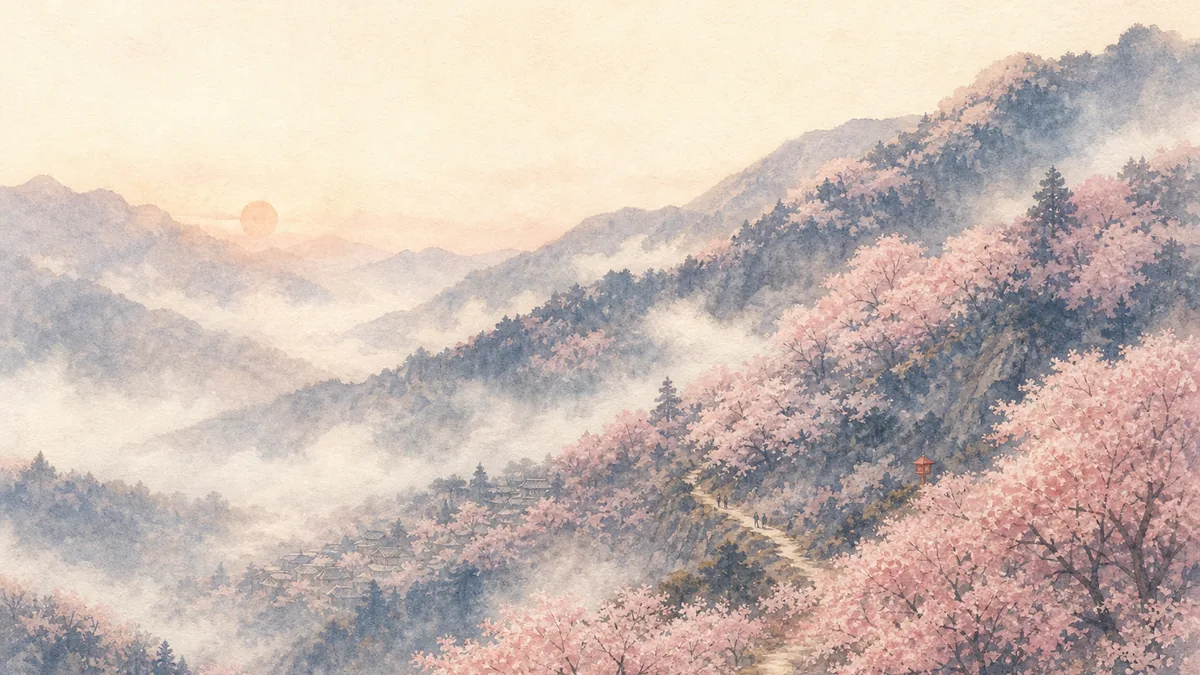
What Yoshino actually is
Mount Yoshino sits in Nara Prefecture, south of the old capital, and it is one of Japan's most storied places to watch cherry trees bloom. The number usually quoted is 30,000 — the town's own tourism page hedges it as "said to be" — and almost all of them are a single species, the white-flowered yamazakura, planted in drifts across the slopes rather than lined up along a boulevard. The local shorthand is hitome-senbon — "a thousand trees at a glance" — which is less a statistic than a promise about what a single hillside view is meant to hold.
The bloom does not arrive all at once. It climbs the mountain from the bottom up, moving through four zones whose names map onto the ascent: Shimo (lower), Naka (middle), Kami (upper), and Oku (inner) senbon. Because of that vertical spread, the flowering stretches over roughly two to three weeks rather than the few days a single grove would give you, typically somewhere in early-to-mid April — though the exact window shifts every year with the weather, so a current bloom forecast is the only date worth trusting.
The mountain is also more than a viewpoint. It forms part of "Sacred Sites and Pilgrimage Routes in the Kii Mountain Range," inscribed by UNESCO in July 2004 — a working spiritual landscape rather than a park. Kinpusen-ji's Zao-do hall, the temple at its heart, is a National Treasure that the temple describes as second in size only to the Great Buddha Hall at Todai-ji among Japan's old wooden buildings: 34 metres tall, 36 metres to a side, rebuilt in 1592. You are booking a night in a place people have walked to on purpose for a very long time, which is part of why the beds are so few.
Two honest strategies (and the trap between them)
There are exactly two plans that survive the 2 a.m. lobby test. Pick one on purpose, early, and the rest of the trip arranges itself around it.
Sleep on the mountain
Lodging on Yoshino runs to small ryokan and shukubo — temple lodgings — with tiny capacity. A place with a handful of rooms fills far ahead for the peak-bloom weekends, and it does not un-fill because the forecast turned or your plans slipped. This is the reservation you make the moment plans exist, not the week you finally get around to a calendar. And before you put money down, read the deposit and cancellation terms slowly: weather does not move your booking, and a rained-out weekend is still a paid one. I am not going to quote you a policy — terms differ by property and they change — so confirm the current ones on the inn's own page before you commit.
What an evening up there actually buys is the part the day-trippers never see. In the late afternoon the crowds drain downhill toward the last trains, and the mountain goes quiet. There are lanterns; the blossom illumination has run in recent seasons — in 2026 it was scheduled from 20 March to 19 April, 18:00 to 22:00 — though whether it runs on your night, and on what dates next year, is a schedule to check rather than assume. Then there is dawn — the blossoms before anyone else has climbed up to reach them. The sober footnote: April nights on a mountain are cold, colder than the city you came from. Pack a warm layer you would not bother with down in Osaka. The person who skipped it is the one shivering on a balcony at 6 a.m. — a reservation that looked warm enough at noon, failing its own late-night test.
Or take the first train
The other honest plan is to give up on sleeping on the mountain entirely, base yourself in Osaka where beds are many and comparatively cheap, and commit to arriving early. Kintetsu runs to Yoshino from Osaka Abenobashi; on the current timetable the limited express takes about seventy-five to eighty minutes, and I would still verify the exact service for your date rather than trust my rounding. From the foot of the mountain a ropeway — opened in 1929, and billed by its operator as Japan's oldest — can carry you up, or you walk. It does not run every day: as of the operator's notice of May 2026, the ropeway works Friday through Monday and a substitute bus covers Tuesday through Thursday, so check which one your day falls on before you build a plan that leans on it. The walk is always there as the backup.
The discipline of the day trip is the return. Midday at Naka-senbon in full bloom is a genuine crush of people, so the reward goes to whoever arrived first, not whoever tried hardest at noon. And you plan the trip home before you climb, not after. This is where the 2 a.m. lobby test turns into the last-train test: the version of you standing at the top of the mountain at dusk, phone fading, needs to already know when the last train down leaves and how to reach it. Look those times up on the operator's own timetable for your date, because a missed last train on a mountainside is a far worse lobby to be stranded in than any hotel's.
Everything between these two plans — "I'll decide when I get there," "we'll find somewhere," "surely something opens up" — is the version that fails. If you are still weighing whether a room or a traditional inn suits you at all, the ryokan versus hotel comparison is worth reading before you chase a mountain shukubo specifically.
Luggage, and the phone that runs the day
Whichever plan you pick, travel light on the mountain itself. This is a slope, not a concourse: lockers are scarce, and I will not pretend to know how many there are on any given day, because it varies and the honest number is "fewer than you would like." Do not haul a large suitcase up an incline in a crowd. If you are moving between hotels — Osaka to the mountain and back, say — send the big bag ahead by the luggage-forwarding service instead of carrying it, and climb with a small day pack. The mechanics of that are their own small art, covered in the luggage logistics guide, and the same principle that saves you at a Tokyo station saves you at the base of Yoshino.
Notice what every part of both plans has in common: it lives on your phone. Bloom forecasts, train and ropeway status, bus timetables, the map from the station to your inn's door — all of it is a screen you will be checking on a mountainside where the WiFi is not going to rescue you. The same lesson runs through a late arrival in Tokyo: the decision always gets made on a phone that either works or it doesn't. On Yoshino there is no lobby WiFi to duck into halfway up the slope.
The lobby at 2 a.m., the mountain at 6 a.m.
Two pictures, and you get to choose which one you are standing in. The first is a lobby at 2 a.m.: a guest who decided to "figure Yoshino out later," phone dead, bag heavy, no room on the mountain and the last train long gone. The second is a hillside at 6 a.m.: someone who booked the moment the plan existed, or who caught the first train down with the return already mapped, standing among tens of thousands of trees before the crowd arrives. The difference between them is not luck. It is a decision made weeks earlier, at a desk, while the coffee was still warm.
Before you book, run the list:
- Pick one strategy — sleep on the mountain, or day-trip on the first train. The middle is where plans fail.
- Book the stay the moment plans exist. Peak-bloom rooms on the mountain go months ahead.
- Read the cancellation terms on the property's own page. Bad weather does not move a paid booking.
- First train beats a late start. Midday at Naka-senbon is the crush; arrive early or don't bother.
- Check the ropeway status before you rely on it, and know the walk is the fallback.
- Pack a warm layer. April nights on the mountain are cold, whatever the city felt like.
- Travel light and forward the big bag. Lockers are scarce and the slope is real.
Do that, and Yoshino in bloom becomes the ordinary miracle it is meant to be, instead of a one-in-the-morning phone call to a night clerk who already knows how it ends. Every booking looks fine at noon. Make the one the 6 a.m. version of you will thank you for.
References
- Yoshino Town (official) — "The story of the cherry trees": the town's own page says the mountain holds what is "said to be 30,000" yamazakura, blooming from early to mid April. town.yoshino.nara.jp — sakura no hanashi
- Yoshino Town (official) — 2026 bloom record, which shows the bloom climbing the mountain: Shimo-senbon opened 27 March (full 1 April), Naka 28 March (2 April), Kami 30 March (4 April), Oku 4 April (9 April). town.yoshino.nara.jp — bloom information
- Yoshino Town (official) — World Heritage: "Sacred Sites and Pilgrimage Routes in the Kii Mountain Range" was inscribed on 1 July 2004, and the town states the inscription includes Mount Yoshino. town.yoshino.nara.jp — world heritage
- Kinpusen-ji (official) — the Zao-do: a National Treasure, 34 m tall and 36 m to a side, "second in size to the Great Buddha Hall of Todai-ji among old wooden buildings," rebuilt 1592. kinpusen.or.jp/about/
- Kintetsu Railway (official) — limited express timetable, Osaka Abenobashi ⇄ Yoshino (revision of 14 March 2026): journeys run 76–80 minutes. kintetsu.co.jp — timetable (PDF)
- Yoshino Omine Cable (official) — ropeway guide and service notice of 28 May 2026: the ropeway runs Friday–Monday and a substitute bus runs Tuesday–Thursday; the company dates the line to 12 March 1929. yokb315.co.jp — service notice · ropeway guide
- Yoshinoyama Tourist Association (official) — spring illumination: 20 March to 19 April 2026, 18:00–22:00. yoshinoyama-kankou.com — spring light-up
- Yoshinoyama Tourist Association (official) — shukubo listings (Chikurin-in, Sakuramotobo, Tonan-in). yoshinoyama-kankou.com — shukubo