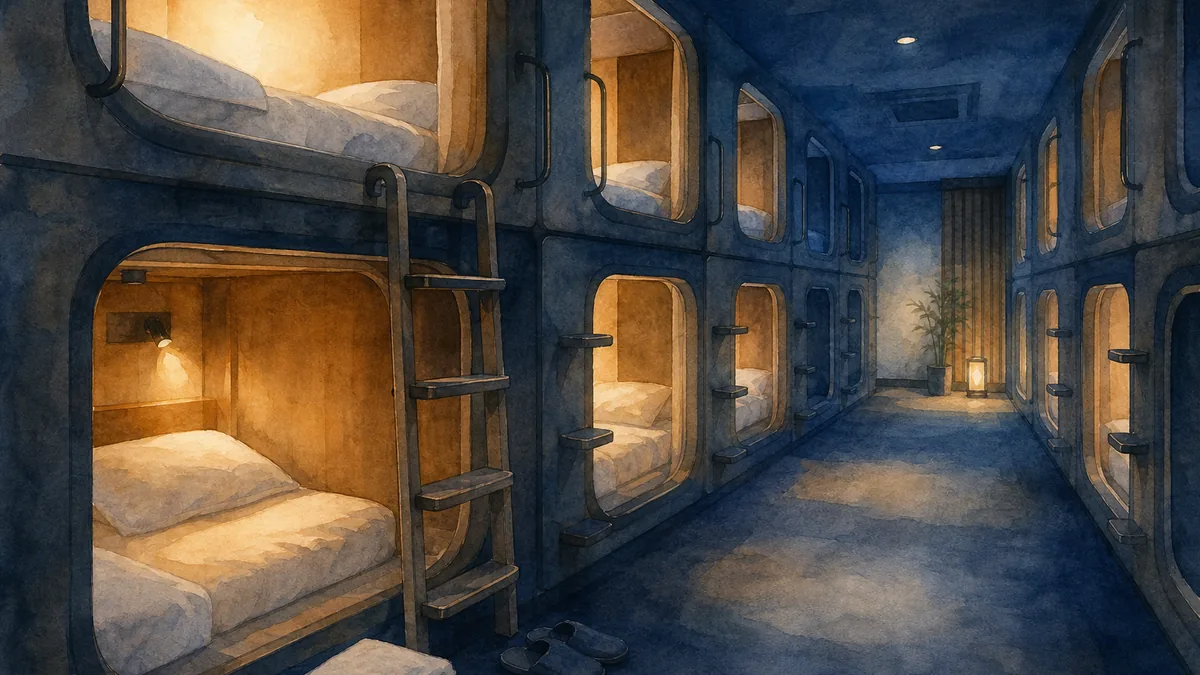
The pod is roughly the size of a large wardrobe laid on its side. Tokyo's official travel guide puts a typical capsule at about 1.2 metres wide, two metres long, and a metre high; properties vary, and the fancier ones run closer to a small room. The height is not an accident of design — where berths are stacked, the enforcement order under the Ryokan Business Act requires roughly a metre of clearance between the upper and lower levels. Inside: a small television, a reading light, a power outlet, a climate control panel, and a fabric blind or roll-down curtain that separates your space from the aisle. That is the whole private domain. And for a certain kind of night in Tokyo — one that values location, cleanliness, and a reasonable cost over floor space — it turns out to be exactly the right amount of room.
Capsule hotels divide people into two camps: those who have not stayed in one and imagine it is a last resort, and those who have stayed in one and treat it as a calibrated choice. This guide is for the first camp, and for anyone who wants to know what they are actually deciding when they consider booking a pod.
What the photos don't tell you
Marketing photography for capsule hotels tends to feature the capsules themselves, often empty, often shot with a wide lens at dramatic angles. This makes them look futuristic and slightly unnerving — orderly rows of coffin-shaped berths, a technology of sleeping.
What the photos don't show is more interesting. They skip the locker room, which is your actual home base for the night — where your bags live, where your yukata (provided cotton robe) comes from, where you return after the bath. They skip the communal bath floor, which at a good property rivals a mid-range hotel spa in cleanliness and design. They skip the lounge, where some newer properties have put serious thought into lighting, seating, and the kind of quiet that is genuinely pleasant to sit inside.
The pod is the private part. All the investment in a well-run capsule hotel goes into the communal spaces, because that is where guests spend most of their non-sleeping hours. The better operators understand this. A capsule hotel with an excellent onsen and a terrible locker room has its priorities backwards; a capsule hotel with a mediocre pod and excellent communal facilities is a very good place to spend a night.
How a capsule hotel is actually organized
The layout follows a consistent logic, though it varies by property:
Ground floor: Front desk, entrance. Shoes come off at the door in most traditional capsule hotels; slippers are provided, or socks are worn. You receive a key or wristband for your locker. This is check-in — typically quick, efficient, and in most central Tokyo properties, manageable in English or with a self-service kiosk.
Locker floor: This is your staging area. Your main luggage lives here. Your yukata is here. Your toiletries go in or near your locker. Everything you don't need in the pod stays here. At a well-organized property, the locker floor is clean, calm, and clearly signed.
Sleeping floor(s): The capsule rows. Even at properties that take both men and women, floors are usually separated by sex. The capsule is yours for the night. Nobody enters it but you.
Bath floor: The communal bath or onsen. At a serious capsule hotel, this is the main event. Quality varies enormously; reviews that mention the bath specifically are worth reading before you book.
Lounge or relaxation floor: Some properties have invested heavily here — recliner chairs, vending machines, reading corners, rooftop terraces at a few locations. The lounge absorbs the time between bath and sleep, and between waking and checkout, with more grace than you might expect.
Couples alert: Traditional capsule hotels separate sleeping floors by gender. Most properties do not offer mixed sleeping accommodation. If you are traveling as a couple and expecting to sleep in adjacent pods, verify this explicitly before booking — it is not the norm.
What your pod contains — and what stays in the locker
Inside a typical Tokyo capsule pod: provided bedding (pillow and duvet or blanket), a reading light with adjustable brightness, a small television (less used now, but present in many properties), one or more power outlets and USB-A or USB-C charging points (newer properties often have better power infrastructure), a climate control dial or button, and a small mirror in some pods. At higher-end capsule hotels, built-in wireless audio and mattress upgrades are increasingly common.
The "door" is almost always a fabric blind or roll-down curtain, and that is a licensing matter rather than a cost-saving one: capsule properties are licensed as kan'i shukusho (simple lodging) under the Ryokan Business Act, and operators state plainly that the law is why the berth cannot be given a lock. It provides visual privacy from the aisle. It does not provide acoustic separation — you will hear other guests at some level, and they will hear you. The noise level in a capsule hotel sleeping area at 11 p.m. is typically low: most guests are tired, and the culture of the space favors quiet. But it is not silent, and light sleepers should factor this in.
What does not go in the pod: luggage, large bags, or anything you are not actively using. Standard lockers at capsule hotels fit carry-on-sized bags comfortably. Large checked-style suitcases may not fit, depending on locker dimensions. If you have large bags, check with the property before booking about their locker sizing — some have a limited number of oversized lockers, and availability is not guaranteed.
Most capsule hotels in Tokyo provide toiletries — shampoo, conditioner, body wash, sometimes face wash — as well as towels and the yukata. You typically do not need to bring your own for a single night. Check what is included in the confirmation or property listing before packing.
The morning, which is where capsule hotels earn their reputation
There is a particular quality to a capsule hotel morning in Tokyo that is worth describing, because it is not what people expect when they picture the experience.
It is quiet. Not silent — there is movement, the sound of lockers opening, distant water from the bath floor — but it is a considered quiet. The people sharing the locker room with you at 6:30 a.m. are moving efficiently, with the kind of consideration for shared space that Japanese public environments generally produce. Nobody is on a phone call. Nobody has left their bags in the middle of the corridor.
At a property with a communal bath, the bath in the morning is the experience that separates a good capsule hotel from a merely decent one. Japanese standards for communal bath maintenance are high. A well-maintained communal onsen in a capsule hotel — clean tile, properly heated water, natural light if the floor permits it — is genuinely pleasant, and not diminished by being part of a budget stay. The price of the bed does not change the quality of the water.
Checkout is typically 10 or 11 a.m. — nine hours' published terms set the capsule window at 3 p.m. to 11 a.m. the following morning, and First Cabin Akasaka checks out at 10 — and the turnaround is tight enough that it is generally held to. A few chains run a different model entirely, with checkouts hours later, so read the property's own terms rather than assuming the format. This is the one moment where the economy of the format shows itself clearly: the room — the pod — has to be ready for the next guest quickly, and the checkout time reflects that. Plan accordingly.
Breakfast, at properties that serve it, tends to be Japanese-style (rice, miso soup, pickles, a piece of fish) or a simple western spread, at a price that reflects the overall economy of the property. It is often a genuinely good deal and worth trying if you do not have somewhere else to be.
Who capsule hotels genuinely suit — and who they don't
Worth booking if:
- You are a solo traveler. Most capsule guests are men and some properties are men-only, but women-only floors and women-only properties both exist in central Tokyo — check that the one you are looking at takes women before you book.
- Budget matters and you want Japanese standards of cleanliness and hospitality without paying for space you won't use.
- You want the experience at least once; it is genuinely distinctive, and the curiosity is a valid reason.
- You are arriving late after a long day and need a clean, quiet, affordable bed in a convenient location.
- You appreciate communal bath culture and are comfortable with shared facilities managed to Japanese standards.
Think twice if:
- You are traveling as a couple expecting to sleep together — verify specifically before booking; most properties separate by gender.
- Enclosed spaces cause you real anxiety. The pod is small by design; that is not a bug, but it matters if you have genuine claustrophobia.
- You have large checked luggage that may not fit in standard lockers; check locker dimensions before booking.
- You are a very light sleeper who needs complete acoustic isolation to function the next day.
- You need the communal bath open late or early; bath hours vary, and the specific window matters if that's part of why you're booking.
One note on the cost comparison: a well-located capsule hotel in central Tokyo occupies a useful middle ground between a dorm bed and a private business hotel room. If privacy is the primary concern, a business hotel is the better value. If location at low cost is the primary concern, and you are comfortable with shared facilities, a capsule hotel makes a clear case for itself. The accommodation type guide covers the broader choice between stay types if you are still deciding where capsule hotels fit in your itinerary.
How to find and book one
Agoda, Booking.com and Google Hotels all list Tokyo capsule hotels in English. Search "capsule" in the property type filter or the keyword field. Which platform carries the widest selection is not something we can verify, and it shifts anyway — if a property you have read about is not showing up, try another platform or the chain's own site before concluding it is full.
A few things worth checking before you confirm:
- Location. Station proximity matters more for a capsule hotel than for most other stays, because you likely have luggage and will be arriving or departing at unusual hours. Check the walking route specifically — see the train line guide for exit-specific navigation advice that applies here too.
- Bath hours. If the communal bath is part of why you're booking, confirm that the hours align with when you plan to use it. Some properties close the bath for maintenance between midnight and early morning.
- Locker size. Mentioned earlier, but worth repeating: check the property listing or contact them directly if you have large bags.
- Reviews mentioning specific details. Reviews that describe the bath quality, the morning routine, the locker room condition, and the noise level at night are more useful than summary star ratings. Look for those specifics.
- Cancellation policy. During cherry blossom season (late March to early April) and Golden Week (late April to early May), well-located capsule hotels fill early. The booking mistakes guide covers peak-season cancellation traps that apply here as much as to regular hotels.
Capsule hotels turn up across central Tokyo rather than in one district, and the neighbourhoods travellers most often end up comparing are Asakusa (traditional neighbourhood feel, often good value), Shinjuku (convenient, many options across price points), Akihabara (modern properties with better power infrastructure), and the area around Tokyo and Ginza stations (some newer, more designed properties). That is an orientation, not a ranking — we have no source for which district actually holds the most. Where you stay depends on where you need to be — use the area guide to orient the neighborhood choice first, then find a capsule hotel within it.
References
- Tokyo Metropolitan Government / GO TOKYO (official) — A guide to capsule hotels in Japan: "A typical capsule has dimensions of something like 1.2m x 2m x 1m"; "even in capsule hotels that allow both men and women, each floor will usually be separated by gender"; "Most patrons of capsule hotels are men, and some capsule hotels are male-only": gotokyo.org — A guide to capsule hotels in Japan
- e-Gov Law Search — Ryokan Business Act (旅館業法), Art. 2: lodging businesses are divided into hotel/inn, simple lodging (簡易宿所営業) and boarding-house operations: laws.e-gov.go.jp — 旅館業法
- e-Gov Law Search — Enforcement Order of the Ryokan Business Act (旅館業法施行令), Art. 1(2): structural standards for simple lodging, including 「階層式寝台を有する場合には、上段と下段の間隔は、おおむね一メートル以上であること」: laws.e-gov.go.jp — 旅館業法施行令
- nine hours (official) — accommodation terms, Art. 8: 「宿泊客がカプセルユニットを使用できる時間は15時から翌朝11時までとします」: ninehours.co.jp/policy
- First Cabin Akasaka (official) — check-in/out 17:00 / 10:00, 「お部屋は男女別フロアに分かれており」, and 「簡易宿所となるため法令上キャビンに鍵をかけることができません」: first-cabin.jp — 赤坂