There are two options on the screen. The first: a Shinjuku business hotel, compact room, high floor, free cancellation, ¥10,000–¥15,000 a night (check current rates on booking platforms). The second: a ryokan two hours toward Hakone, tatami room, multi-course dinner and breakfast included, onsen, ¥25,000–¥40,000 per person. Both within budget. The question is not really which is cheaper. It is what you want the trip to be.
For first-time visitors to Japan, this is probably the most consequential lodging decision you face — not because one choice is wrong, but because they represent genuinely different things. Getting clear on the difference before you open a booking site saves you from paying for something that doesn't fit your itinerary, or missing something that might have been the best night of the trip.
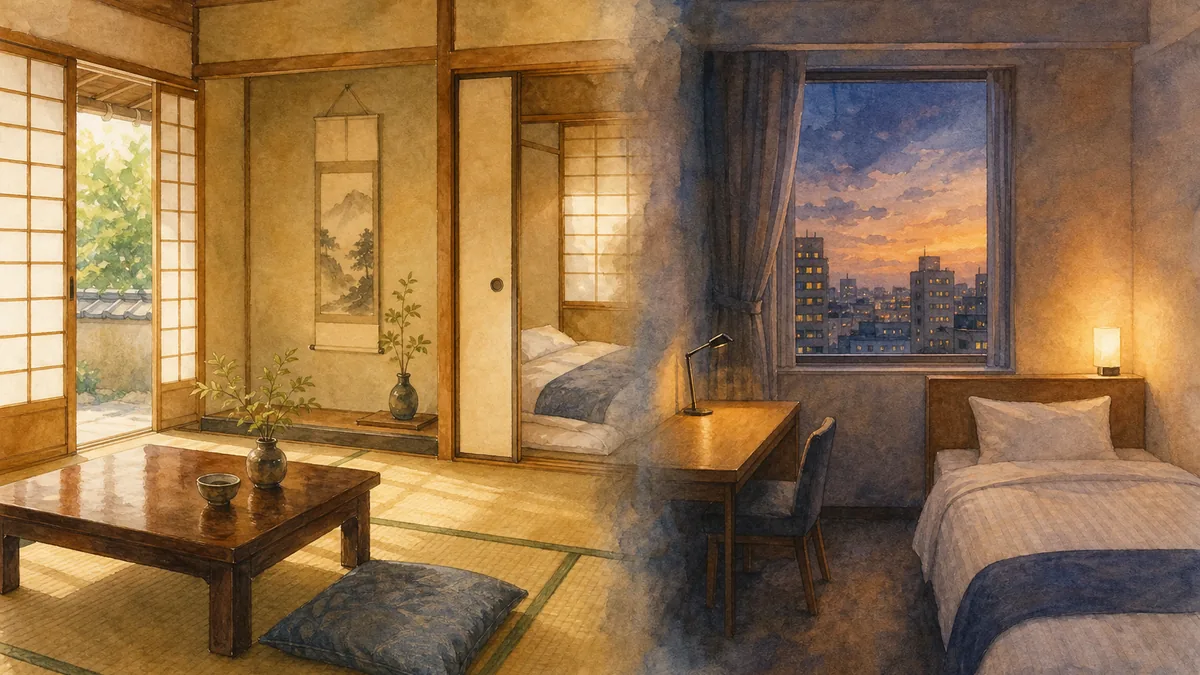
What you're actually choosing between
The business hotel is a city tool: a quiet, efficient base that stays out of your way. You sleep there, leave early, come back late, and it accommodates all of that without complaint. The room is small — chains publish the figure, and singles commonly land somewhere between 12 and 17 square metres — but designed with the kind of precision that makes small rooms work. Japanese business hotels have elevated this format to a minor art form.
The ryokan is a different proposition entirely. You are not booking a room; you are buying into an evening and a morning. Dinner arrives, course by course, at a set time. The bath is ready. The futon is laid out while you eat. Breakfast comes with the same care. The schedule is the product. If you approach a ryokan as a hotel with added formality, it will feel constraining. If you approach it as a structured experience of Japanese hospitality, it is something quite different.
Neither is inherently better. They serve different trips — and understanding which one you're actually on is the decision.
What a Tokyo business hotel actually gives you
The practical case for a Japanese business hotel is strong:
- Location. Business hotels are almost always within a few minutes' walk of a major train station, often connected directly underground. In Tokyo, where transit is the connective tissue of everything, this matters more than it sounds.
- Flexibility. Check-in is from roughly 15:00, with late arrivals handled without drama. Free cancellation is the norm on refundable rates. Nothing about your evening is locked in.
- No meal commitment. You eat when and where you want. This is significant if you plan to eat out every night, arrive too late for a set dinner, or simply dislike the idea of a scheduled evening.
- Predictability. A decent mid-range business hotel in Shinjuku delivers roughly what a decent mid-range business hotel in Ueno delivers. The range of surprise is narrow, and that's often the point.
The trade-offs are real. The rooms are genuinely small. If you have two large suitcases, a 14-square-metre room requires some spatial negotiation. Bathrooms are compact, in a Japan-specific configuration — tub, shower, and toilet in a single moulded unit — that visitors either find ingeniously efficient or mildly claustrophobic. And breakfast, if not included in your rate, is purchased separately: sometimes an excellent hotel buffet, sometimes a vending machine and a convenience store on the corner.
Room sizes vary significantly even within the same price band. Many Japanese booking sites list square metres — check that number before confirming. Ten square metres and eighteen square metres are not the same experience with luggage.
What a ryokan gives you — and what it requires
A traditional ryokan has a recognisable shape. You arrive and are welcomed into a tatami room. Yukata (lightweight cotton robes) are provided and worn to the bath, to dinner, in the corridors. Dinner comes at a set time — often 6 or 7 p.m. — in multiple courses of kaiseki cuisine, considered one of the peaks of Japanese culinary tradition. The futon is laid out while you are at dinner. The communal or private onsen bath is yours before sleep. Breakfast comes in the morning with the same care. Checkout is around 10 a.m.
What this experience requires of you:
- Arriving during check-in hours. Ryokan check-in windows run roughly 15:00 to 18:00. Arriving after 18:00 without advance notice risks missing the dinner service. Communicate late arrivals in writing when you book, not when you appear.
- Respecting the meal schedule. You cannot eat elsewhere for dinner and expect your ryokan dinner to hold. The kitchen operates on a timeline. If you think you might eat out, book a ryokan plan without dinner and confirm that option exists when you reserve.
- Communicating dietary restrictions early. Kaiseki menus are fixed, but most ryokan can accommodate restrictions with advance notice. State them clearly when you book, not when you sit down.
- Understanding the pricing model. Ryokan rates are typically quoted per person, not per room. A "¥30,000 ryokan" for two people costs ¥60,000. This surprises first-timers more than almost any other Japan booking detail. See the booking mistakes guide for more on this specific trap.
On communal bathing: onsen at ryokan are almost always gender-separated by default. Many properties also offer private onsen (貸切風呂) that couples can reserve. Tattoo policies vary; some properties have restrictions on tattoos in shared facilities. Confirm this before you book if it's relevant to your group.
A working comparison
| Factor | Business Hotel | Ryokan |
|---|---|---|
| Price structure | Per room | Per person (usually) |
| Meals | Sold separately; optional | Dinner + breakfast typically included in the rate |
| Check-in | Flexible from ~15:00; late arrivals OK | Window (~15:00–18:00); late must be flagged in advance |
| Checkout | Around 11:00 | Around 10:00; often enforced |
| Room style | Western bed, compact | Tatami with futon (usually) |
| Bath | En-suite, compact | Communal onsen or private reservation; varies by property |
| Location | Urban, transit-adjacent | Often hot spring town, coast, or mountain setting |
| Evening schedule | None; eat wherever, return whenever | Set dinner time; structured evening is part of the stay |
| Flexibility | High; free cancellation common on refundable rates | Lower; cancellation fees common and often start early |
| English support | Good at most mid-range chains | Variable; specialist English booking services help significantly |
Prices, cancellation policies, and meal plans change. Verify current terms with booking platforms and properties before confirming.
When the business hotel is the smarter call
Choose a business hotel — for all or most of your Japan trip — when:
- You are doing intensive city sightseeing and want to return late without worrying about anyone's schedule but your own.
- You are arriving from a long-haul flight and need maximum flexibility on arrival night more than you need an experience.
- Your itinerary is primarily city-centre based — Tokyo, Osaka, and Kyoto urban sightseeing — without overnight escapes planned.
- Budget is genuinely tight and you want to allocate spending toward food and experiences rather than the room.
- You plan to eat out every night, and a set meal would go to waste.
- Your trip is short — five days or fewer — and you want to maximise mobility rather than settling in one place.
A well-run mid-range Tokyo business hotel is a genuinely good place to stay. It is not a compromise. Many people who have been to Japan a dozen times stay only in business hotels, by choice, every trip.
When one ryokan night changes how you see Japan
Book a ryokan — at least for one night — when:
- Your itinerary has room for a night outside the city. Hakone, Ito, Atami and Nikko are all within reasonable reach of Tokyo, and hot-spring areas are where ryokan make the most coherent sense. A night in one of these settings is among the experiences that distinguish Japan from anywhere else. (Kinosaki Onsen gets named in the same breath, but it belongs in a different bracket: its own tourist association puts the rail journey from Tokyo Station at about four hours forty minutes, via shinkansen to Kyoto and a limited express from there. It is a destination, not a night away from the city.)
- You want to understand Japanese hospitality (omotenashi) from the inside, not as a concept. The ryokan is where that concept is most fully expressed.
- You are traveling as a couple interested in a shared, unhurried evening rather than another restaurant and a late return.
- Your trip is long enough — seven or more days — that absorbing one slower night doesn't feel like a sacrifice.
The cost reframing that helps clarify the decision: what looks expensive in headline terms usually includes two substantial meals. A ¥30,000-per-person rate covering a full kaiseki dinner and a traditional Japanese breakfast is not the same purchase as a ¥10,000 hotel room. The honest comparison is ¥30,000 versus ¥10,000 hotel plus two good restaurants. Framed that way, many ryokan are competitive — and the experience is one you cannot replicate in a city hotel at any price.
Most travelers who spend one night at a proper ryokan return to Japan specifically to do it again.
The middle ground worth knowing
Between the business hotel and the full traditional ryokan, there are options that borrow from both:
- Small urban inns in Asakusa and the older parts of Tokyo — Japanese-style rooms, communal baths, included breakfast, without the remote location and kaiseki schedule. A useful introduction to inn culture without leaving the city.
- Machiya townhouse stays — whole-home rentals in restored Kyoto townhouses, offering the atmosphere of traditional Japan with modern amenities and the freedom to come and go on your own schedule.
- Boutique hotels with Japanese design elements — properties with tatami areas, wooden interiors, and curated aesthetics, but western beds and no fixed dinner. These work well for travelers who want the visual and spatial experience of Japan without a structured evening.
For context on how these stay types fit across Tokyo's different neighborhoods, the area guide covers the neighborhood dimension, and the train line guide adds routing and transit context for wherever you choose to base yourself.
Booking each one in English from overseas
Business hotels are well-covered on all major global platforms: Booking.com, Agoda, Expedia, and Rakuten Travel's English site. The search experience is familiar. Cancellation policies are clearly displayed. English-language support is available if something goes wrong at check-in.
Ryokan booking in English is more nuanced. The global platforms carry some ryokan, but selections are uneven and the nuances of meal plan terms sometimes get lost in translation. Three routes widen the choice:
- The ryokan's own site. Many properties take direct reservations and set out the meal plan in full there, often in more detail than an aggregator listing carries. If the property has an English page, this is usually the clearest description you will find of what your rate includes.
- Japanese domestic platforms. Jalan (jalan.net) and Rakuten Travel (travel.rakuten.co.jp) sit at the top of the domestic field: the Japan Travel and Tourism Association's survey of estimated visitors to Japanese travel sites, covering 2022, placed Jalan first and Rakuten Travel second on both desktop and mobile. Both are Japanese-language, but a browser translation covers most of the booking flow.
- Inbound-focused services. WAmazing (wamazing.com) is built for overseas visitors and covers accommodation, transport tickets and activities in English.
One caution specific to this category: several English-language ryokan booking agencies that older guides still recommend have since closed or been folded into other businesses, and their domains now redirect elsewhere. Check that a booking site is live and currently trading before you enter card details.
Whichever you choose, if your travel dates fall during cherry blossom season (late March to early April), Golden Week (late April to early May), or November foliage season: book as far ahead as you can, and choose a refundable rate where one is available. Ryokan cancellation fees are common and often begin well before the stay. Read the terms before you confirm. The booking mistakes guide covers this and other peak-season traps in detail.
References
- Japan National Tourism Organization — Guide to Bathing in Japan (gender-separated baths; reserving a private kashikiriburo). Accessed 2026-08-01.
- Japan Ryokan & Hotel Association — English search pages (rates listed per person). Accessed 2026-08-01.
- Kinosaki Onsen Tourism Association — access and journey times (Tokyo, approx. 4 hr 40 min by rail). Accessed 2026-08-01.
- Japan Travel and Tourism Association / Values Inc. — 2022 estimated-visitor ranking for travel websites (PDF, 14 Feb 2023). Accessed 2026-08-01.
- Cabinet Office of Japan — national holidays (Golden Week dates, 29 April – 5 May). Accessed 2026-08-01.
- Japan Meteorological Agency — cherry blossom flowering dates. Accessed 2026-08-01.
- Hotel Route-Inn Grand Tokyo Toyocho — room specifications (singles 14.7–17 m²); Tokyo Inn, Ota City — room specifications (singles approx. 12 m²). Accessed 2026-08-01.
- Japan National Tourism Organization — trip planning: japan.travel/en/plan/