A front desk at night sees the same handful of mistakes on a loop. None of them are dramatic. Nobody gets scammed, nothing catastrophic happens. It's smaller than that: a guest booked by photo and price, then found out on arrival that the "10-minute walk" from the station was closer to twenty with two suitcases, up a flight of stairs with no elevator in sight. Someone paid for a rate that couldn't be changed, the week before their plans changed. A room turned out to be smaller than the bedroom they'd left at home.
None of these are exotic errors. They're ordinary, they repeat constantly, and every one of them is avoidable once you know what to check before you confirm the booking, not after you've checked in.
The station walk that isn't in the listing photo
Search filters lead with price and photos, so that's what gets compared first. The station name attached to a listing gets skimmed, if it's read at all. That's backwards. In a city built around its rail network, the walk from the platform to the front desk shapes daily life on the trip more than almost anything else about the room.
Before booking, check which station the property actually uses — not just the neighborhood name on the listing — and look at the walking route on a map rather than trusting the number the listing gives. "8 minutes" on a booking site is a straight line drawn by someone who never dragged a suitcase over it. Add real time for crossing lights, underground concourses, and finding the one correct exit out of a station that may have a dozen of them.
The walk you'll actually make, with luggage, at the end of a long day
A common front-desk scene is a guest arriving visibly worn down, later than planned, because the route from the station turned out to include a staircase with no elevator, a stretch under construction, or a hill that the map drew as flat. Japan's train stations are not uniformly accessible. The transport ministry measures step-free access mainly at the busier ones, and as of the end of the 2023 financial year 93.9 per cent of the stations in that group — those handling 3,000 passengers a day or more, plus certain designated ones above 2,000 — had step-free access by lift or equivalent. That leaves a remainder even among the busy stations, and the quieter ones sit largely outside what that figure counts at all. Some stations have lifts at every exit; older or smaller ones sometimes don't, or the lift serves only one exit that isn't the one nearest the hotel.
If two large suitcases are coming along, or anyone in the group has mobility considerations, look up that specific station's accessibility before booking, not after. Check satellite or street view for the actual route. A hotel two minutes closer to a station with a working elevator is usually the better booking, even over one that's marginally cheaper but two minutes from a station without one.
What "compact" means once the door is open
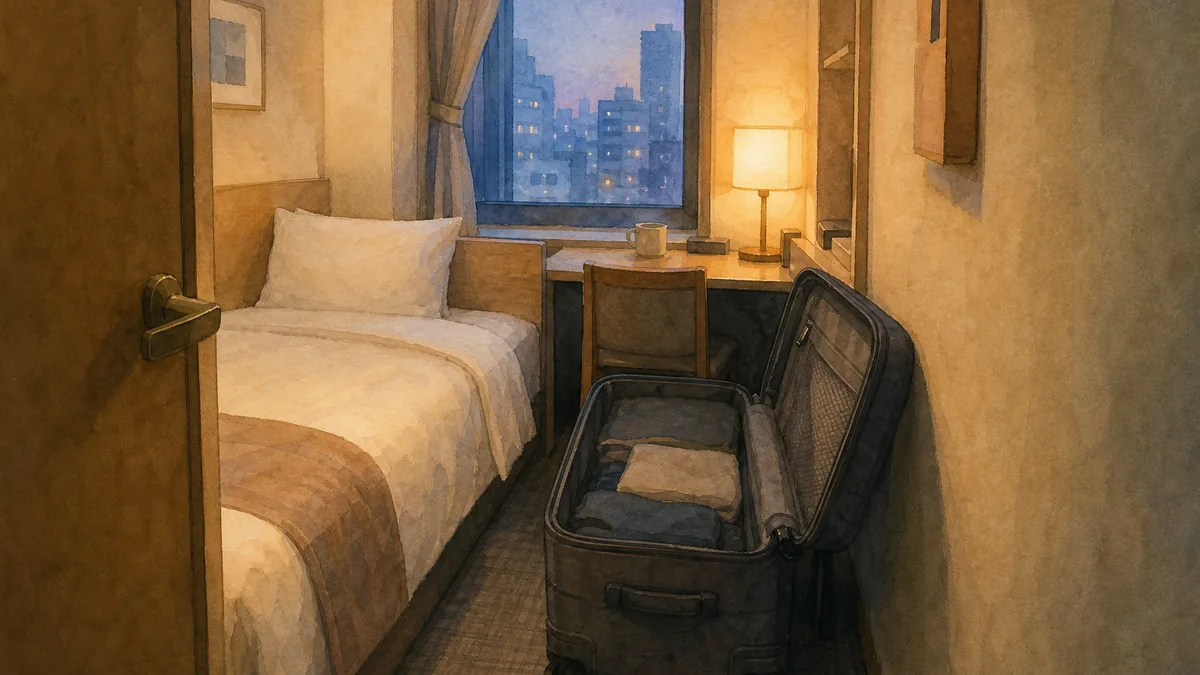
Room size is where expectations and reality diverge hardest for first-time visitors. Japanese hotel rooms, especially in central Tokyo, are built to a different standard of normal than most overseas travelers expect. A room that's genuinely comfortable for one traveler with a carry-on can feel tight for two people with two full suitcases.
Most Japanese booking sites list the room size in square metres. Read that number before booking, not just the photo. A wide-angle lens makes a 12-square-metre room look roomy on a screen. In person, that's a bed, a narrow path around it, and not much else.
Traveling as two with two full-size suitcases: look for rooms in the high teens of square metres or above. Under about 15 square metres usually means one suitcase stays zipped and stacked in a corner for the whole stay.
The "sale" rate that can't move with you
Discounted rates that are non-refundable or non-changeable are usually marked clearly, and they're usually meaningfully cheaper — which is exactly why they're tempting to lock in before an itinerary is settled. The trap isn't the discount. It's booking that rate while flights, connecting cities, or travel companions are still being worked out.
A locked non-refundable rate is a fine choice once dates are firm. It's a bad choice while a flight is still held open on two dates, or a travel companion hasn't confirmed the time off yet. If there's any real chance the dates move, the flexible or free-cancellation rate is worth the extra cost upfront — a cheaper non-refundable rate can usually be booked later once things settle, but the reverse doesn't work.
Arriving late without telling anyone
Not every property in Japan runs a staffed front desk around the clock. Smaller hotels, guesthouses, and many ryokan work to a check-in window, and once it closes, the desk can be genuinely unstaffed rather than just quiet. A late flight, a missed connection, or a delayed train can turn "I'll check in whenever I get there" into standing outside a locked door with no one to call.
If there's any chance of arriving after the stated check-in window — after an overnight flight, a late landing into Narita or Haneda, a delayed connection — say so in advance. Most booking confirmations include a way to message the property directly, or a phone number for exactly this situation. A short note a day ahead is usually enough to arrange a key box, a later staffed window, or at minimum confirm someone will be there.
Keeping a way to reach the property matters here too. If a train delay is turning a late arrival into a very late one, sending an update in real time — rather than showing up unannounced two hours past what was said — is the difference between a minor note on file and a missed booking. It's one more reason having working mobile data from the moment of landing is worth sorting out before the trip, not after arrival.
Ryokan meals run on their own clock, not yours
A ryokan stay is often priced with dinner and breakfast built in, served at a set time chosen by the kitchen, not by the guest. This is one of the most common sources of ryokan disappointment for first-timers: arriving late and hungry, expecting to check in and figure out dinner from there, only to learn the multi-course meal was timed for an hour earlier and can't simply be reheated and served at nine.
Check the meal times when booking, and be honest about the day's itinerary. Coming straight off a long train transfer or a full day of sightseeing, either build in enough buffer to arrive well before the dinner seating, or book a room-only or breakfast-only plan and eat before arrival. Ryokan kitchens plan service around confirmed arrival times; they generally can't improvise around a guest who shows up two hours late.
The line item that shows up at checkout
Two different local taxes can land on the bill, and they are not the same thing under Japanese law, however similar they look on a receipt. An accommodation tax (shukuhaku-zei) is one a city or prefecture has to create for itself by ordinance, and only some have done so — Tokyo since 2002, Osaka, Kyoto, Kanazawa, Fukuoka, Kitakyushu, Nagasaki and a short but steadily growing list of others. Because each sets its own rate, it might be a flat amount per person per night banded by room price — Tokyo charges ¥100 or ¥200 depending on the rate — or a straight percentage of the room charge, as in Kutchan. Separately, if the property has a hot-spring bath, a bathing tax (nyūtō-zei) applies. That one is national in origin rather than local invention: the Local Tax Act requires municipalities where hot-spring baths are located to levy it, at a standard rate of ¥150 per bather per day. Neither is large, and a stay at an onsen town hotel can attract both. What makes them worth knowing about is that they are easy to miss when comparing headline rates across booking sites, and they are often collected in cash at checkout rather than charged to the card used to book.
When budgeting, especially for a larger group or a longer stay where it adds up, check whether the destination charges an accommodation tax and keep a little cash aside for checkout. The property's own site or booking confirmation usually states it if it applies.
Cherry blossoms, festivals, and the weeks everyone else is booking too
Cherry blossom season, Golden Week, major local festivals, and the autumn foliage weeks aren't a secret. Everyone traveling to Japan around those windows is looking at the same limited inventory, and prices in popular areas climb well ahead of the dates while the best-located rooms sell out first. Waiting to book "closer to the date, once plans are firmer" during one of these windows usually means paying more for less choice, not less.
If a trip lands on or near one of these periods, book earlier than feels necessary, and hold a refundable rate if the dates aren't fully locked yet. If there's any flexibility at all, shifting even a few days off the peak window can meaningfully change both price and availability.
The name on the booking has to match the passport
This one is a legal requirement rather than a house rule, and it applies specifically to foreign guests who do not hold an address in Japan — which means essentially every overseas visitor. For those guests the property is required to record nationality and passport number in its guest register, and the health ministry instructs properties to ask to see the passport and keep a copy filed alongside that register. In practice the desk reads the passport and checks it against the name on the reservation. A booking made under a nickname, a maiden name, a travel companion's account, or a slightly different spelling than the passport shows can turn a routine check-in into an extended conversation at the desk — usually resolvable, but not how anyone wants to start a stay after a long flight.
Book under the exact name on the passport that will be presented at check-in, written the way it appears on that document, not however it's usually spelled elsewhere.
Early check-in and late check-out are requests, not rights
Standard check-in and check-out times exist because housekeeping needs that window to turn a room around. Arriving hours before check-in and expecting a ready room, or assuming a late checkout will simply be granted because the flight isn't until evening, is a common source of friction at the desk — and usually a paid arrangement even when it is granted.
If early check-in or late check-out actually matters to the plan, ask the property in advance rather than assuming it on arrival. Many hotels will hold luggage for free even when the room isn't ready, which solves the practical problem — freedom to go out sightseeing unencumbered — without needing the early check-in itself.
A short sanity check before confirming
Before clicking confirm on a booking, run through this:
- Station and route confirmed on a map, not just the listed walk time — checked for stairs, elevators, and construction if traveling with heavy luggage.
- Room size in square metres checked against how much luggage and how many people will be in it.
- Rate flexibility matched to how firm the dates actually are — refundable if anything could still change.
- Late-arrival plan in place if there's any chance of missing the standard check-in window, with the property notified in advance.
- Ryokan meal times checked against the day's arrival schedule.
- Local accommodation tax checked, with a little cash set aside if it applies.
- Peak-season dates booked early, on a refundable rate if plans aren't fully locked.
- Booking name matched exactly to the passport that will be shown at check-in.
- Early check-in or late check-out requested in advance, not assumed at the desk.
Sources
- e-Gov Law Search — Hotel Business Act (旅館業法), Article 6 and its Enforcement Regulation (旅館業法施行規則), Article 4-2(3): properties must keep a guest register, and for "a guest who is a foreign national without an address in Japan" it must record their nationality and passport number. Accessed 2026-08-01.
- Ministry of Health, Labour and Welfare — 日本国内に住所を有しない外国人宿泊者に係る旅券の写しに関する取扱いの周知について (Notice Kenei-hatsu No. 0123001, 23 January 2008): properties are instructed to ask such guests to present their passport and to keep a copy of it together with the guest register. Accessed 2026-08-01.
- e-Gov Law Search — Local Tax Act (地方税法), Articles 701 and 701-2: municipalities where hot-spring baths are located levy a bathing tax on bathers, at a standard rate of ¥150 per person per day. Accessed 2026-08-01.
- Ministry of Internal Affairs and Communications — 法定外税の実施状況(令和6年度) (status of non-statutory local taxes, as of January 2025; PDF): lists every prefecture and municipality levying an accommodation tax, with each one's start date and rate. The bathing tax does not appear in this list at all, because it is a statutory tax under the Local Tax Act rather than one a local government creates. The accommodation tax list has continued to grow since this edition. Accessed 2026-08-01.
- Ministry of Land, Infrastructure, Transport and Tourism — 鉄軌道における駅や車両のバリアフリー化の進捗状況 (24 December 2024): at the end of FY2023, 3,331 stations (93.9%) had step-free access, measured across stations averaging 3,000 or more passengers per day plus designated stations averaging 2,000–3,000. Accessed 2026-08-01.