The gate reads your ticket and the crowd resumes at its own speed, which is faster than yours. You have two large cases. Somewhere past the turnstiles there is an escalator, and somewhere past the escalator — not beside it, rarely beside it — there is an elevator. You do not yet know where. The signs assume you already do. Behind you, a wheel catches the metal lip of the gate and swings the case sideways into your heel.
No photograph prepares you for this part of a Tokyo trip. The city is not hard to move through. It is hard to move through with weight.
Most planning treats luggage as a footnote — a line item you deal with once, at the airport, and then forget. It is closer to a second traveler: slower than you, unable to take stairs, particular about elevators, and present at every transfer you make. When a hotel says it is eight minutes from the station, that number is written for a person with empty hands who already knows which exit to use. Your suitcase did not read the listing.
This guide is about the route the suitcase takes. Plan that route first, and the version of Tokyo you move through gets noticeably lighter.
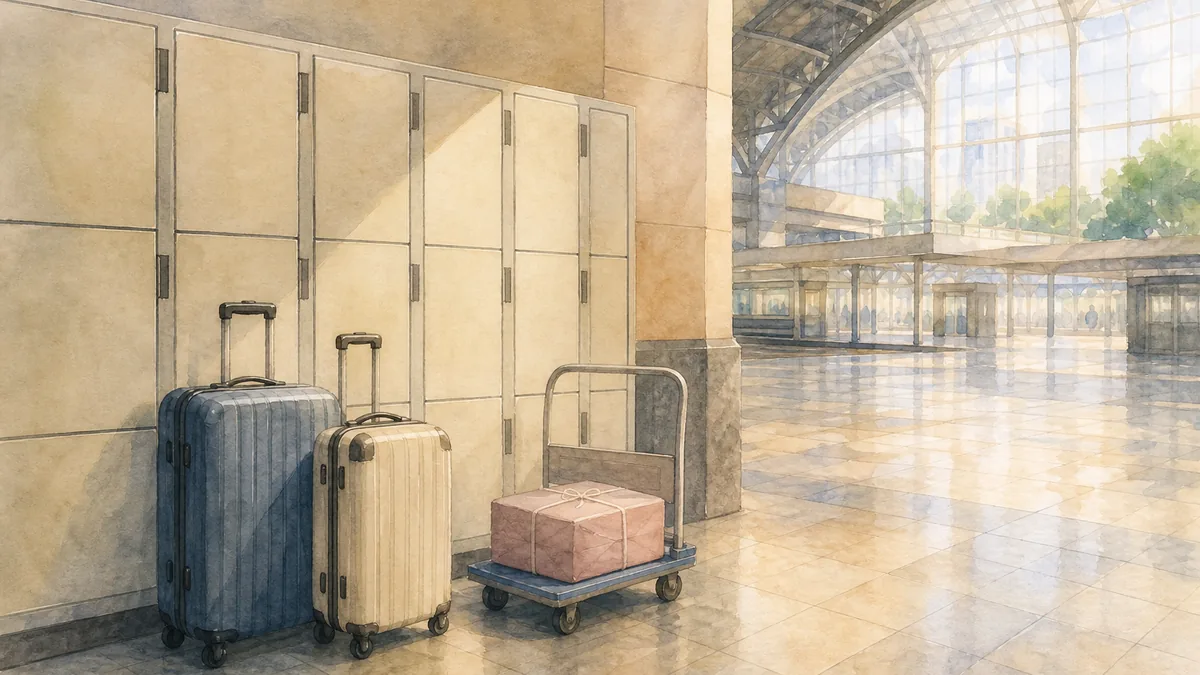
Weight travels its own route
Two hotels can be the same distance from the same station and sit at opposite ends of a luggage day. One is reached by a wide, covered corridor and an elevator that opens near the gate. The other is a shorter line on the map, but it crosses a pedestrian overpass with a flight of stairs at each end, and the only elevator is back the way you came.
A route planner will call the second one closer. With a case in each hand, it is farther. The difference is not distance; it is the number of times you have to lift.
So the first move is a reframe. Before you compare neighborhoods or read a single review, ask a narrower question: on the two days luggage actually moves — arrival and departure, plus any change of base in between — what does the bag have to climb? Everything after that is easier to decide.
Tokyo stations are vertical, and the elevator is the real map
The map you are handed shows lines and stations. The map that matters on a luggage day shows floors. Large Tokyo stations stack ticket gates, platforms, passages, and exits across several levels, and the connections between them are stairs and escalators far more often than elevators.
Escalators are not a reliable answer. Some are narrow, some run only one direction at a given hour, and some are busy past the point where a large case is welcome; signage may ask luggage and strollers to use the elevator instead. It is worth knowing exactly what the accessibility rules do and don't promise. The ministerial standard requires at least one step-free route between the public thoroughfare and the train door at each platform — and where that route has a change in level, it must be served by a ramp or a lift, with an escalator permitted only where neither is structurally possible. So the guarantee is a step-free path, not necessarily a lift. The target also has a threshold: it covers stations averaging 3,000 or more passengers a day, plus certain 2,000–3,000 stations in designated priority districts. As of the end of the 2023 financial year, 3,331 of those stations — 93.9 percent — had achieved step-free access. High, but not all of them, and not all by elevator. Where lifts do exist they are placed for step-free access rather than for your convenience: there may be one per concourse, at the far end from where you arrive.
Find the elevator before you travel, not at the gate. Station operators publish facility and barrier-free maps that mark elevator locations and step-free routes, and several transit apps show them too. Note the elevator nearest your exit the way you would note a platform number — and confirm close to your date, because stations rebuild and a step-free route can end up behind a construction hoarding.
The transfer tax
Every transfer is a small vertical negotiation: off the train, find the level change, find the elevator, wait, ride, repeat toward the next platform. Empty-handed, a transfer costs a few minutes. With luggage, it costs the whole sequence — and it repeats on the way back.
This is why the fastest route and the lightest route are often not the same line on the screen. A journey with one transfer and a slightly longer ride can be easier to carry than a journey with two transfers that saves you a few minutes. Route apps rank by time. They do not rank by lifts.
Read a route the way the suitcase will:
| If your trip looks like this | What the route map hides | The lower-friction read |
|---|---|---|
| Two transfers, all "quick" | Each transfer is its own stair-and-elevator hunt | A one-transfer route, even a few minutes slower, usually carries easier |
| "8 min walk" from the station | Assumes the right exit, no bags, no overpass | Check which exit has the elevator, and whether the walk is flat |
| A tight airport connection with cases | No margin to find the elevator or wait for it | Give the luggage leg extra time, or move the bag separately |
| Change of base mid-trip | A travel day spent hauling instead of seeing | Consider forwarding the case and travelling light that day |
None of these say a route is always best. They say: when weight is in your hands, count lifts, not only minutes — and confirm the specifics for your own stations, because layouts and services differ.
The locker question, and its limits
Coin lockers are the obvious tool for a few free hours between check-out and a late train, and Tokyo has many of them. They come in rough size bands — small, medium, and large — and alongside the old key lockers, many modern facilities now take the same IC transit card you tap through the gate. Do not assume it: an older bank of lockers may still want coins.
Two things trip people up. The large lockers, the ones that swallow a full suitcase, are the scarce ones; near major stations and tourist areas they fill early on busy days, and a plan that depends on finding one can fail at the worst moment. Some stations show live availability on a screen or through an app — the thing to check before you commit to a locker-shaped afternoon. Fees vary by size, station, and duration, so confirm the rate at the locker itself rather than trusting a number from a blog.
The deeper limit is simpler. A locker solves hours, not days. It holds your bag while you visit a museum; it does not move your bag to the next city. For that, Tokyo has a better answer.
The move most visitors miss: send the bag ahead
Japan runs on door-to-door luggage delivery — takkyubin, or luggage forwarding. Hotel front desks routinely arrange it, dedicated counters sit inside the airports, and convenience stores handle it too. You hand over the case, fill in a slip with the receiving address, and travel that day with a small bag while the suitcase meets you at the next hotel.
For a transfer-heavy travel day, this changes the shape of the day entirely. A move from Tokyo to a mountain town and on to another city — the kind of itinerary that would otherwise be a stair marathon with cases — becomes a light train ride, because the heavy bag is taking its own route by truck. You carry a day's essentials; the suitcase arrives on its own.
A few conditions decide whether it works cleanly, and all of them are worth confirming rather than assuming:
- Timing. Delivery often lands the next day between major areas, but it can take longer to distant or remote regions, and same-day is not the norm. Confirm the delivery window at the counter when you send, and hand the bag over early enough to matter.
- The receiving end. Ask that your next hotel will accept and hold a delivery before your arrival; smaller inns may have limits. Give the front desk the reservation name and date.
- The gap. Your big bag will not be with you the night you send it. Keep one change of clothes, chargers, medication, and anything valuable in the bag you carry.
- Cost and rules change. Prices depend on size, weight, and distance, and services update their terms; check the current fee and conditions with the operator rather than a fixed figure.
Used well, forwarding is the single biggest reduction in luggage friction available in Japan. It is also the least visible to first-time visitors, because nothing in a standard hotel search mentions it.
Choosing a hotel by luggage friction
Once you think in lifts, hotel selection reads differently. Station proximity is still a filter — but proximity to which exit, reached how, matters as much as the number of minutes in the listing.
A few questions separate a low-friction hotel from a tiring one, and none of them are about the room itself:
- Which exit, and does it have an elevator? A hotel by the elevator-served exit can be genuinely closer, on a luggage day, than one nearer a stairs-only exit.
- Will they hold your bags? Most hotels store luggage before check-in and after check-out, but confirm it — that answer decides whether your first and last days are free or spent tied to a suitcase.
- Is the route flat? A slightly longer walk on the level beats a shorter one over an overpass with stairs at both ends.
- Is there an elevator inside the hotel? Smaller and older properties may not have one, which turns a third-floor room into a staircase with a suitcase.
Read against your trip, it resolves quickly:
| If your trip looks like this | Weigh the hotel by |
|---|---|
| Late arrival, one Tokyo base, no moves | Step-free path from your arrival gate to the door, and pre-check-in bag hold |
| Several bases across Japan | A hotel that forwards luggage, so each change of base is a light day |
| Big cases, budget property | An in-hotel elevator and a flat walk, not just the nightly rate |
| Early departure by long-distance train | Bag hold on the last morning and a short, flat roll to the departure station |
This is about the route, not the room. A quiet, well-run hotel is still a quiet, well-run hotel; luggage friction is a separate axis, and worth weighing on its own. For how station and line choice shapes the same decision, see the companion guide on choosing a Tokyo hotel by the train line you'll use; for matching a neighborhood to your itinerary, the area guide; and before you confirm any rate, the common booking mistakes to avoid.
The first luggage decision is made at the airport
The friction starts before the first train. Landing with full cases, you have two routes out of arrivals: haul the bags onto the airport train and through your first transfers, or hand them to a delivery counter and travel light while they follow.
Neither is automatically right. Hauling keeps everything with you and can be simpler for a single, direct ride to a nearby hotel. Forwarding buys a lighter arrival — a real gain after a long flight, especially if your route into the city involves transfers — at the cost of a wait: the case will not reach the hotel that first night, so your carry-on has to cover it. Both airports have delivery counters in the arrivals area; the route logic for which train to take in the first place is its own subject, covered in the train-line guide.
Whichever you choose, the tools that make a luggage day work — station facility maps, live locker availability, forwarding pickup times, the walking route to the right exit — all live on your phone, which is one more thing to have working before you land rather than after.
Plan the bag's route first
The version of Tokyo that feels effortless is not the one with the shortest lines on the map. It is the one where the suitcase's route was decided at the booking stage: the elevator located, the transfer avoided, the heavy bag sent ahead on the day it would have cost you the most.
Do that, and the gate at nine at night becomes ordinary. The ticket reads, the crowd moves past, and you go the way you already knew to go — no wheel against your heel, no elevator to hunt for, because you found it weeks ago, sitting at a desk, with the map open.
References
- e-Gov Laws — Ministerial Ordinance on Standards for Barrier-Free Transport Facilities, Article 4 (one step-free route per platform; a ramp or a lift where there is a change in level). Accessed 2026-08-01.
- Ministry of Land, Infrastructure, Transport and Tourism — progress on railway barrier-free access, end of FY2023 (3,331 stations, 93.9%; the 3,000-passengers-a-day threshold). Published 24 December 2024; accessed 2026-08-01.
- Yamato Transport — how long TA-Q-BIN takes (next day or the day after, by destination) and sending from a convenience store. Accessed 2026-08-01.
- Narita Airport — baggage delivery counters; Haneda Airport — delivery services (arrival lobby). Accessed 2026-08-01.
- Japan National Tourism Organization — luggage and storage (coin lockers; IC transit card payment at many modern facilities). Accessed 2026-08-01.