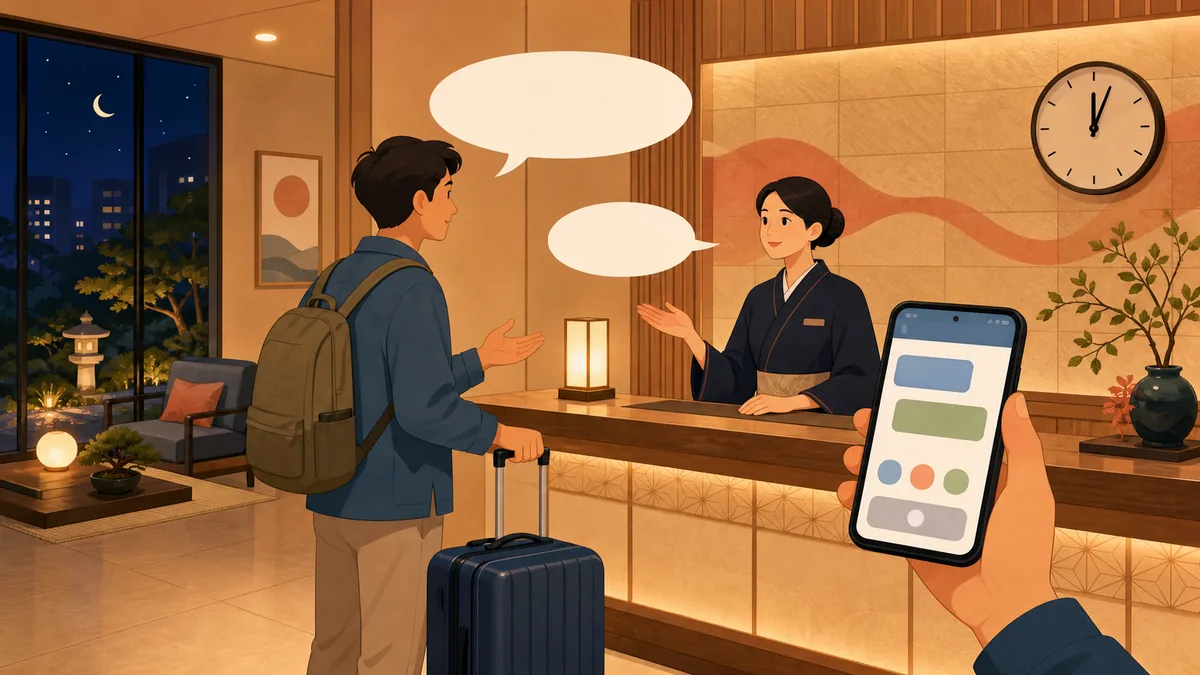
The suitcase wheel always breaks in the rain, and the front-desk clock always reads past midnight when you finally need a sentence you don't have. I have missed elevators that turned out not to exist, tried to explain a tattoo through a not-quite-open door, and once stood holding a laundry basket like it was some kind of diplomatic gift, unsure who to hand it to. None of these scenes really happened to me — they're built the way a phrasebook should be built, out of small objects and worse timing — but the fix in each one is real: one short, polite sentence, said at the right desk, before you need it more than you'd like to admit.
What follows are ten situations a traveller in Japan runs into more often than the guidebooks let on, each with the phrase that gets you through it, written three ways so you can read it, say it, and know exactly what you just said. None of these sentences promise a hotel will say yes — they only get you a clear answer instead of a guess. Prices, hours, and house rules change by property and by season, so treat every "what to confirm" note as a nudge to check the hotel's own booking page before you lean on it.
1. Storing Luggage Before You Can Check In
The suitcase arrives at the hotel three hours before the room does — this is the arithmetic of every red-eye flight, and no one mentions it until you're standing in the lobby with a boarding pass still creased in your pocket and a wheel dragging behind you like an argument you lost. The front desk usually has a back room for exactly this problem.
「チェックインの前に、荷物を預かっていただけますか?」(Chekku-in no mae ni, nimotsu o azukatte itadakemasu ka?) — Could you hold my luggage before check-in?
Confirm before you rely on it: whether the service is free or a small per-bag charge, and whether there's a size limit — some smaller properties keep a single shelf for this, not a room. Our luggage logistics guide covers the fuller picture, including lockers and forwarding services for anything too big for that shelf.
2. Storing Luggage After You've Checked Out
Checkout is 11 a.m.; the flight home isn't until nine that night. In between is a whole city you'd like to see without towing a suitcase through it, and the same desk that took your bag on arrival can usually take it again on the way out.
「チェックアウトした後も、荷物を預かってもらえますか?」(Chekku-auto shita ato mo, nimotsu o azukatte moraemasu ka?) — Could you still hold my luggage after I've checked out?
Confirm before you rely on it: the pickup cutoff, especially if the front desk itself closes before you're back that evening — the luggage logistics guide has the backup plan for that exact gap.
3. Arriving After the Front Desk Has Closed
The delay was thirty minutes, then ninety, then the last local train instead of the express you'd planned around, and now it's past midnight and the hotel's front door has the particular darkness of a building that has already decided you're not coming tonight. Send the message before you're standing in that darkness, not after.
「夜遅くに到着すると思います。何時までフロントは開いていますか?」(Yoru osoku ni tōchaku suru to omoimasu. Nanji made furonto wa aite imasu ka?) — I think I'll arrive late at night. Until what time is the front desk open?
Confirm before you rely on it: the exact procedure for arrivals after closing — a key box code, a side entrance, a phone number to call from outside — and get it in writing before you leave for the station. The arriving late at night guide walks through what a locked lobby actually looks like and how to talk your way through it.
4. A Heavy Bag and No Elevator
The listing photo showed a charming wooden staircase and did not mention that it was also the only staircase, three flights, for a bag packed right up to the airline's weight limit. Charm and cardio are not always the same amenity.
「エレベーターはありますか?」(Erebētā wa arimasu ka?) — Is there an elevator?
「荷物を運ぶのを手伝っていただけますか?」(Nimotsu o hakobu no o tetsudatte itadakemasu ka?) — Could you help me carry my luggage?
Confirm before you rely on it: ask the elevator question at booking, not at arrival — smaller ryokan and older machiya-style inns are genuinely stairs-only, and don't assume a porter is on duty just because a hotel's website mentions one.
5. The Room Is Smaller Than the Photo Promised
The bed looked wider online, the way beds always do through a lens wide enough to fit the whole room into one frame. Somewhere between the photo and the door, a double became something closer to a generous single, and the suitcase now lives on top of it because the floor has nowhere else to put it.
「部屋を変えていただくことは可能ですか?」(Heya o kaete itadaku koto wa kanō desu ka?) — Would it be possible to change rooms?
Confirm before you rely on it: that a change is even possible on a full night, and whether it comes with a fee. Trust the square-meter figure in the listing more than the photo beside it — it's the one number a wide-angle lens can't stretch.
6. Onsen and 大浴場 Rules — Tattoos, Towels, Timing
The tattoo is small — a single line on the inside of a wrist, chosen years before anyone mentioned hot springs — and it's still enough to stall a traveller at the locker-room door, second-guessing a rule that changes from one building to the next. Ask before you're standing there in a towel working it out alone.
「タトゥーがあるのですが、大浴場を利用できますか?」(Tatū ga aru no desu ga, daiyokujō o riyō dekimasu ka?) — I have a tattoo — is it all right for me to use the large communal bath?
「大浴場は何時から何時までですか?」(Daiyokujō wa nanji kara nanji made desu ka?) — What are the hours for the communal bath?
Confirm before you rely on it: tattoo policy varies property to property, and it's worth emailing about ahead of the trip rather than discovering the answer at the door; a small cover seal or a reserved private bath are common workarounds if the answer is no. Once you're in, the small towel is for washing and modesty, not for the water itself — keep it out of the bath.
7. Breakfast Times — and Skipping Breakfast
The receipt says breakfast is included, which is a promise with a closing time attached, and the closing time does not care that the alarm never went off after two flights and a nine-hour shift in the clock.
「朝食は何時からですか?」(Chōshoku wa nanji kara desu ka?) — What time does breakfast start?
「朝食をキャンセルすることはできますか?」(Chōshoku o kyanseru suru koto wa dekimasu ka?) — Can I cancel breakfast?
Confirm before you rely on it: the last-order time, not just the opening time, and whether skipping it actually changes the room rate — some plans price breakfast in whether or not you show up for it.
8. Coin Laundry and Getting Laundry Done
Day six of a nine-day trip is when the suitcase stops closing properly, and the culprit is never the souvenirs — it's the laundry that should have happened on day three and didn't.
「コインランドリーはありますか?」(Koin randorī wa arimasu ka?) — Is there a coin laundry?
「洗剤も売っていますか?」(Senzai mo utte imasu ka?) — Do you also sell detergent?
Confirm before you rely on it: whether the machines take coins or a prepaid IC card, and the hours — some are in an unlocked area open all night, others keep the same schedule as the front desk.
9. A Forgotten Item After Check-Out
The charger is still in the wall socket two train lines away, remembered only once the gate agent calls the flight and there's no time left to go back for it. This is the moment the front desk becomes the most useful phone number in the country.
「忘れ物をしてしまったのですが、届いていませんか?」(Wasuremono o shite shimatta no desu ga, todoite imasen ka?) — I think I left something behind — has it been found?
Confirm before you rely on it: how long the hotel holds items and how they'll ship one on to you, usually a cash-on-delivery courier, and get a written confirmation before you board so the request doesn't rest on someone remembering a phone call.
10. A Wake-Up Call, a Taxi, and an Early Departure
The train is at six, which means the taxi is at five-fifteen, which means someone needs to be awake at five to make sure of any of it — and the surest way to guarantee that is to make it someone else's job too, not only an app's.
「明日の朝7時にモーニングコールをお願いできますか?」(Ashita no asa shichi-ji ni mōningu kōru o onegai dekimasu ka?) — Could I get a wake-up call at 7 tomorrow morning?
「タクシーを呼んでいただけますか?」(Takushī o yonde itadakemasu ka?) — Could you call a taxi for me?
Confirm before you rely on it: whether a staff member is actually on the early shift to greet you and settle the bill, or whether an unstaffed lobby means a key-drop box and a taxi you'll need to call yourself — ask this the night before, not at five in the morning.
Quick-Reference Phrase Table
A short table for the phone lock screen — the polite, everyday version of each phrase above, in case you need it fast and the paragraph around it is three floors away.
| Situation | Japanese | Romaji | Meaning |
|---|---|---|---|
| Luggage before check-in | 荷物を預かっていただけますか? | Nimotsu o azukatte itadakemasu ka? | Could you hold my luggage? |
| Luggage after checkout | チェックアウト後も荷物を預かってもらえますか? | Chekku-auto go mo nimotsu o azukatte moraemasu ka? | Could you hold my luggage after checkout? |
| Late arrival | 何時までフロントは開いていますか? | Nanji made furonto wa aite imasu ka? | Until what time is the front desk open? |
| No elevator | エレベーターはありますか? | Erebētā wa arimasu ka? | Is there an elevator? |
| Change rooms | 部屋を変えていただくことは可能ですか? | Heya o kaete itadaku koto wa kanō desu ka? | Would it be possible to change rooms? |
| Onsen tattoo question | タトゥーがあるのですが、大浴場を利用できますか? | Tatū ga aru no desu ga, daiyokujō o riyō dekimasu ka? | I have a tattoo — can I use the communal bath? |
| Breakfast hours | 朝食は何時からですか? | Chōshoku wa nanji kara desu ka? | What time does breakfast start? |
| Coin laundry | コインランドリーはありますか? | Koin randorī wa arimasu ka? | Is there a coin laundry? |
| Forgotten item | 忘れ物をしてしまったのですが、届いていませんか? | Wasuremono o shite shimatta no desu ga, todoite imasen ka? | I left something behind — has it been found? |
| Wake-up call / taxi | モーニングコールをお願いできますか? / タクシーを呼んでいただけますか? | Mōningu kōru o onegai dekimasu ka? / Takushī o yonde itadakemasu ka? | Could I get a wake-up call? / Could you call a taxi? |
None of these ten sentences is complicated, and that's rather the point — a short, polite question asked at the right desk does more for a trip than a long paragraph said to no one. Practice them before you need them, keep the kanji visible on your phone in case your own pronunciation gets lost in a noisy lobby, and confirm the details that actually change trip to trip — hours, fees, house rules — on the hotel's own booking page rather than on a stranger's essay about a suitcase that never existed. The suitcase will still be the suitcase. At least the sentence will be ready before it is.
Sources
- Japan National Tourism Organization — Onsen Hot Springs: On Tattoos and Etiquette: tattoo policy at public baths is "very case-by-case," and the small towel provided is for covering and washing yourself but "must be kept out of the water." Accessed 2026-08-01.
- Japan Tourism Agency / Ministry of Health, Labour and Welfare — 入れ墨(タトゥー)がある外国人旅行者の入浴に関する対応について (notice to hotel and ryokan industry associations, 16 March 2016; PDF). Lists covering a tattoo with a sticker, and offering a private or room-attached bath, among the response examples suggested to properties — the two workarounds named in section 6. Accessed 2026-08-01.
- Japan National Tourism Organization — How to Best Enjoy Japan's Onsen: wash and rinse completely before entering the bath; keep towels and long hair out of the water. Accessed 2026-08-01.