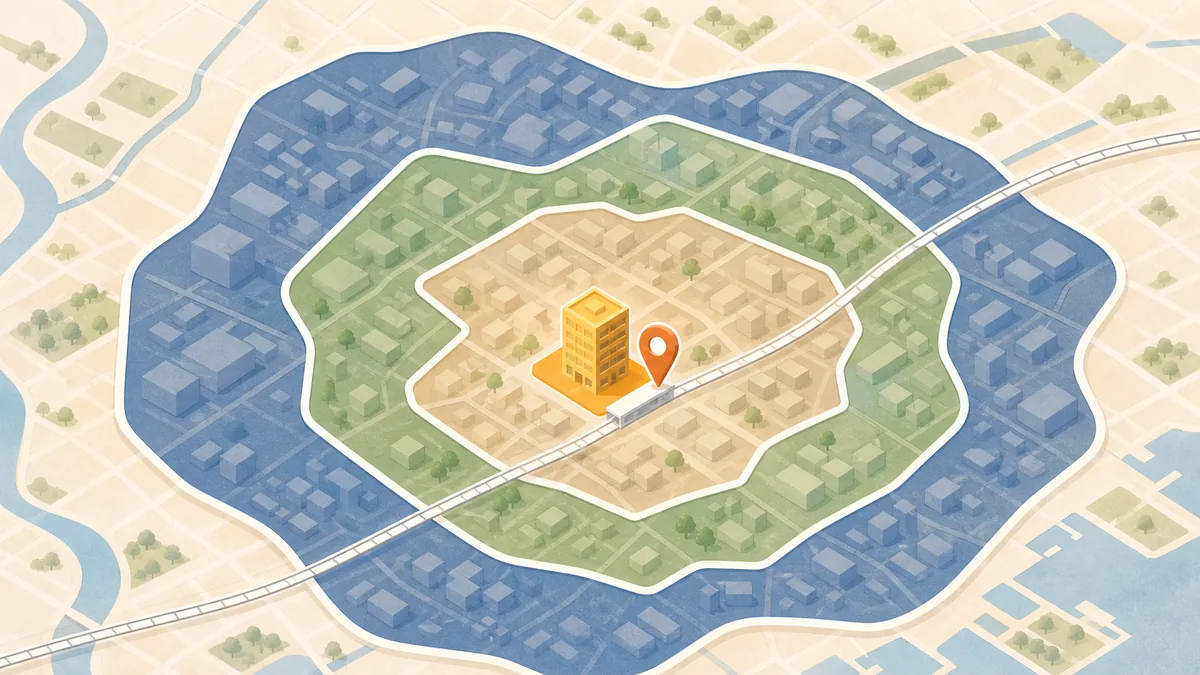
A Tokyo hotel listing can print a street name that means almost nothing to the people living two doors down, because Japan does not organize addresses by street at all. The digits and kanji that actually tell you something are the ones tied to a train line, a station, and an exit number. Learn to read both, and a booking page stops being a wall of unfamiliar characters and starts working like a route: how far you will walk, how many stairs stand between you and your room, and how much of your first evening gets eaten by geography before you have even unzipped a bag.
Forget the Street Name Above the Door
Most Tokyo buildings have no name posted at street level, and the road they sit on usually has no name at all outside a handful of major avenues. That surprises a lot of first-time visitors who grew up trusting a street address to place them within a block. In Japan, the address is built around administrative areas, not roads. A hotel confirmation might list something like Tokyo-to, Chiyoda-ku, Marunouchi 1-chome, 2-2, and none of those segments is a street. They are nested areas, each one smaller than the last, and the building number at the end tells you almost nothing about direction or distance until you know where the boundary lines actually sit. This is also why so many shops and offices hand out small printed maps instead of reciting an address out loud. A map showing the nearest station and a landmark does the job a street name cannot.
How a Tokyo Address Is Actually Built
The order runs from the largest unit down to the smallest, the reverse of a typical Western address. Prefecture first, then ward or city, then a named district, then a numbered sub-area called chome, then a block number, then a building number. Each layer narrows the search area, but none of them draws a line down a road the way a street address does.
| Part of the address | Japanese term | What it marks | Example fragment |
|---|---|---|---|
| Prefecture | 都 (to) | Tokyo as the top-level region | Tokyo-to |
| Ward | 区 (ku) | A city-sized administrative unit inside Tokyo | Chiyoda-ku |
| District | 町 or a named area | A named neighborhood, not a road | Marunouchi |
| Chome | 丁目 | A numbered sub-area within that neighborhood | 1-chome |
| Block | 番 (ban) | A cluster of buildings inside the chome | 2-ban |
| Building number | 号 (go) | The specific building within that block | 2-go |
Put the pieces together and you get the compressed form hotels usually print: chome, block, and building number strung together with hyphens, such as 1-2-2. It reads clean on a screen. It tells you almost nothing about which direction to walk from a station until you have looked at an actual map.
Two Numbering Systems, and Why It Matters Which One You're Reading
Japan runs two different systems side by side, and travellers routinely hear only the confusing half of the story. Under the newer residential indication system, introduced by a 1962 law and used across most built-up areas including central Tokyo, the numbers are not arbitrary at all. A municipality divides the perimeter of each block into intervals of roughly 10 to 15 metres, then walks that perimeter clockwise from a fixed starting corner, assigning consecutive base numbers as it goes. A building takes the number of the interval its main entrance opens onto. Buildings with consecutive numbers on the same stretch of frontage are, as a rule, genuinely next to each other.
The older system is where the disorder lives. Land parcel numbers, the chiban recorded in the property register, were assigned as parcels were registered and subdivided rather than by any geographic logic, so on a map they do not necessarily run in sequence at all. Plenty of areas outside the main urban districts still address themselves this way, and that is where two consecutive numbers can genuinely sit on opposite sides of a block.
The practical upshot is the same in both cases, for a different reason than travellers usually assume. Even a perfectly regular clockwise number tells you which frontage of which block a door sits on — it says nothing about which station you should walk from, which side of the block faces your route, or how long any of it takes. The number identifies a location. It does not describe a path to it.
The Real Locator: Line, Station, and Exit Number
Ask someone in Tokyo for directions and they will rarely reference the address at all. They will name a train line, a station, and often an exit number or letter, because that combination is what actually orients a route through the city. A hotel description that says "five minutes from Shinjuku Station" is only useful once you know which of Shinjuku's many exits it is measuring from, since a large interchange station can have a dozen or more exits scattered across a footprint the size of several city blocks. The station name tells you the neighborhood. The exit number tells you which side of that neighborhood you will actually land in. Treat the exit number as part of the address, not as an optional detail, and cross-check it against a map before you assume a short walk in either direction. Stations served by more than one line or operator often stack exits and platforms on different levels, so the same station name can mean two very different routes depending on which company's gate you come through.
Reading "X Minutes From the Station" Like an Editor
Any stated walking time on a listing page is an estimate made by someone, using an assumed pace, on a route they may not have walked with a rolling suitcase. Some listings measure from the nearest ticket gate. Others measure from the building itself to the platform, which can be a very different number once you add the time to walk the length of the station and find the right gate. Treat a single stated minute figure as a floor rather than a promise, and expect to add time for stairs, an unfamiliar exit on your first pass through, or a queue for an elevator during a busy hour. A listing that says three minutes and a listing that says eight minutes are both worth verifying on a map before you compare them, because "minutes from the station" is not a standardized measurement across booking platforms.
Exit Numbers, Stairs, and Suitcases
Large stations were not built with luggage in mind. Some exits connect directly to street level with an escalator or elevator nearby. Others require a flight of stairs with no lift in sight, particularly at older or smaller exits away from the main concourse. If you are dragging a suitcase, the difference between the exit closest to your hotel and the exit with a working elevator can matter more than the difference between a five-minute walk and a nine-minute one. This is worth checking before arrival rather than after you have already hauled a bag up two flights in July heat. It connects directly to luggage logistics, since the easiest route on paper is not always the easiest route with wheels.
Matching the Line to Your Airport and Your Day
Once you can read an address and locate a station and exit, the next question is whether that station's line actually serves your trip. A station five minutes on foot from your hotel is not much of an advantage if the line running through it requires two transfers to reach the airport express or the museum you are visiting most days. The deeper mechanics of picking a line, understanding express versus local service, and weighing one station against another for your specific itinerary are covered in the guide on choosing a hotel by train line. Address literacy tells you where a hotel sits on the map. Line selection tells you whether that spot actually fits your route.
A Short Checklist Before You Book
Before confirming a room, pull up the listed address on a map service and look for the nearest station name and, if given, the exit number. Search the station name plus "exit map" to see whether an elevator serves that exit, since not every exit does. Note whether the walking time given is measured from the ticket gate or the building entrance, and treat any single number as approximate rather than exact. If the listing gives no exit number at all, that is worth a message to the property or a closer look at the map yourself rather than an assumption.
A few quick reads, framed around how your trip actually looks:
- If you are arriving straight from the airport with a suitcase, weigh the elevator question above the walking-time question.
- If your days will center on one train line for meetings, museums, or a particular ward, an address one line over can add a transfer you did not plan for, even when the walk to that other station looks short on paper.
- If you are staying more than a few nights, a slightly longer but flat, escalator-served walk usually beats a shorter one bracketed by stairs at both ends.
None of this replaces judging the room, the price, or the amenities on their own merits. It simply keeps the route separate from the review, so a strong score on one does not quietly stand in for a rough one on the other. For a broader view of how neighborhoods differ beyond the station question, the overview on where to stay in Tokyo is a reasonable next stop. Transit rules, fares, and station layouts change from time to time, so confirm current details on official transit and booking pages before you finalize a plan.
Sources
- e-Gov Law Search — Act on Indication of Residential Address (住居表示に関する法律, Act No. 119 of 1962), Articles 2–3: defines the block system (街区方式) and requires municipalities to assign and publicly announce block symbols and residence numbers. Accessed 2026-08-01.
- City of Kodaira, Tokyo — 住居表示の住所の表し方: the perimeter of each block is divided at intervals of 10 or 15 metres and numbered clockwise from the southwest corner. Accessed 2026-08-01.
- City of Funabashi — 「住居番号」と「地番」、「家屋番号」は違うんですか?: residence numbers are assigned to buildings in order, on a fixed basis, and are a different code from the land parcel number. Accessed 2026-08-01.
- Setagaya City — 地番と住居表示実施前の住所(旧住所): land parcel numbers change as parcels are subdivided in the register, so on a map they do not necessarily run in numerical order. Accessed 2026-08-01.
- Japanese addressing system — general overview of the address hierarchy. Accessed 2026-07-19.