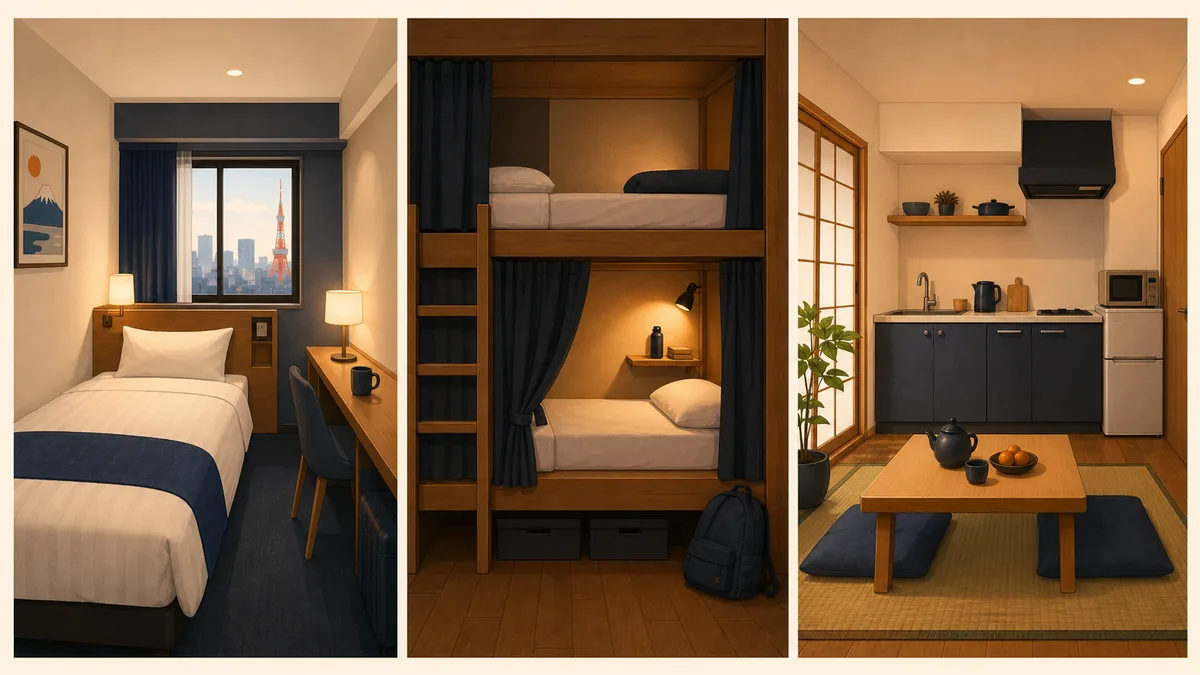
If you have spent any time searching for a place to sleep in Tokyo, you have probably run into the same quiet math every first-time visitor does: how much is reasonable to spend per night, and what do you actually get for it. Call it the ¥5,000 question. It is less about one specific price tag and more about a budget line in your head, and the three most common answers to it are a Japanese business hotel, a hostel or guesthouse, and a short-term rental booked through a platform like Airbnb. Each one solves the "where do I sleep" problem in a genuinely different way, and picking the right one for your trip matters more than chasing the lowest number on a search results page.
Why This Choice Feels Bigger Than It Is
Part of the anxiety around first-time booking in Japan comes from not knowing what these categories actually mean on the ground. "Hostel" conjures images from other countries that may not match a quiet Kyoto guesthouse. "Business hotel" sounds corporate and dull, but it is often the single best value format in Japanese travel. And "Airbnb" carries legal baggage in Japan that it does not carry everywhere else. Once you understand what each type actually delivers, the decision gets a lot less stressful, and it usually comes down to how much you value privacy, company, and flexibility on this particular trip.
Japanese Business Hotels: Small Rooms, Consistent Comfort
The Japanese business hotel is a domestic invention built for traveling salespeople who needed a clean, private, no-fuss room near a train station, and it has become one of the best-kept secrets for budget-conscious leisure travelers too. Rooms are compact, often built around a "unit bath," a molded plastic bathroom pod that packs a toilet, sink, and shower into a space barely bigger than a closet. That efficiency is the whole point: you are paying for a private bed, a private bathroom, air conditioning, and reliable wifi, not for square footage.
- Best for: travelers who want predictability, privacy, and a home base close to a train line without paying for extra space they will not use.
- Trade-off: rooms can feel genuinely tiny, especially with two people and full suitcases. There is rarely a lounge or communal area, so it is not a format built for meeting other travelers.
- Good to know: chains vary a lot in consistency. Reading recent reviews for the specific branch, not just the chain name, will tell you more than the brand alone.
Hostels and Guesthouses: Budget Space With Built-In Company
Hostels and guesthouses trade some privacy for lower cost and, often, a social layer that a hotel room simply cannot offer. Many modern Japanese hostels have moved well past the old dorm-bed-and-nothing-else stereotype: you will find capsule-style bunks with curtains and personal lockers, shared kitchens, common lounges, and sometimes private rooms with a shared bathroom down the hall. This format tends to sit at the more affordable end of the spectrum, which is why it is a natural first stop for anyone stretching a long trip across multiple cities.
- Best for: solo travelers, younger travelers, and anyone who wants to meet people or values a communal kitchen and lounge over a large private room.
- Trade-off: shared bathrooms, thinner walls, and dorm noise are real considerations if you are a light sleeper. Even "private" rooms in guesthouses can be small and simply furnished.
- Good to know: check whether a listing is a true dorm bed or a private room before you book. The word "hostel" in Japan covers both, and the difference in privacy is significant.
Short-Term Rentals in Japan: What "Airbnb" Actually Means Here
This is the category where first-time visitors most often get tripped up, because "Airbnb" is a brand name, not a legal category, and Japan regulates short-term home rentals more tightly than many other countries. Legitimate short-term rentals operating in Japan generally fall under the Housing Accommodation Business Act (住宅宿泊事業法, jūtaku shukuhaku jigyō hō), commonly known as the minpaku system. Under this law, an operator must file a notification (todokede) with the prefectural governor or the equivalent local authority and display the notification number. The 180-night ceiling is not a common case or a local rule — it is the definition: the Act covers lodging "where the number of days on which guests are accommodated does not exceed 180 days in one year." Municipalities can only tighten that further by ordinance, never loosen it.
What this means for you as a booker is simple in practice: before you commit to a short-term rental, look for a visible notification number on the listing, and treat a listing that lacks one as a red flag rather than a bargain. Regulations and local rules can and do change, and enforcement varies by city, so this is genuinely a "verify before you book" situation rather than something to assume based on what a listing page claims. The Japan Tourism Agency (観光庁) runs an official minpaku information portal that explains the system, and it is the reference point if you want the current picture rather than a summary written months or years ago. One thing it does not give you: there is no public, traveler-facing directory of individual registered properties. The portal publishes lists of registered booking agents and property managers, plus running totals of filed notifications — so the number on the listing is still something you check against the listing itself, not something you look up in a national register.
- Best for: groups or families who want a kitchen, laundry, and more square footage than a hotel room, and who are comfortable managing self check-in without front desk staff.
- Trade-off: no reception desk if something goes wrong, inconsistent cleaning quality between listings, and the legal patchwork described above. Some buildings and neighborhoods restrict or ban short-term rentals outright.
- Good to know: confirm the notification number, read the house rules for check-in and noise, and message the host with questions before you pay. A responsive, specific host is usually a good sign.
Side-by-Side: Which Type Fits Your Trip
| Type | Best for | Privacy & space | Watch out for |
|---|---|---|---|
| Japanese business hotel | Solo or couple travelers who want a reliable private base near a station | Private room and bathroom, but compact, sometimes very compact | Little to no communal space; branch quality varies more than chain reputation suggests |
| Hostel or guesthouse | Solo travelers, budget-focused trips, and anyone who wants a social scene | Ranges from shared dorm beds to small private rooms with shared bathrooms | Noise and thin walls; confirm whether you are booking a dorm bed or a private room |
| Short-term rental (minpaku / Airbnb) | Groups and families wanting a kitchen, laundry, and more living space | Most private and spacious option, but no front desk or on-site staff | Must be a lawfully notified listing with a visible notification number; 180 nights a year is the legal ceiling |
Two More Options Worth Knowing About
These three categories cover most budget bookings, but they are not the only budget-friendly formats in Japan. If ultra-compact, ultra-cheap sleeping pods sound appealing, or you just want to see how far Japanese space efficiency can go, our capsule hotels in Tokyo guide walks through what to expect. And if part of your trip includes wanting a more traditional Japanese stay, tatami floors, a yukata robe, maybe an onsen bath, that is a different category entirely from anything above; our ryokan vs hotel comparison explains how that experience differs from a standard hotel and what it tends to involve.
What to Check Before You Book, Whichever Type You Choose
- Read the cancellation policy closely. Budget rates, especially non-refundable ones, can lock you in.
- Check the actual distance to the nearest train station in minutes, not just on a map. Tokyo blocks are often longer and more indirect than they look.
- For any short-term rental, confirm the notification number and read recent reviews specifically about check-in and communication.
- For hostels, confirm dorm versus private room, and check whether the bathroom is shared or ensuite.
- Remember that prices for all three categories shift with season, neighborhood, and demand, so the same room type can cost noticeably more during cherry blossom season or a major holiday week than during a quiet month.
Location matters just as much as lodging type. A great business hotel in the wrong part of the city can cost you more in train time than it saves you in rate, and the same goes for a beautifully cheap hostel that is an hour from anything you actually want to see. If you have not settled on a neighborhood yet, our guide to where to stay in Tokyo is a good next stop before you lock in a booking.
The Bottom Line
There is no universally correct answer to the ¥5,000 question, only the right answer for your specific trip. A solo traveler who wants a quiet, no-surprises base will usually be happiest in a business hotel. A traveler who wants to meet people and stretch a budget across many nights will often prefer a hostel. A family or small group who wants space, a kitchen, and room to spread out may be better served by a properly registered short-term rental, as long as you take the extra step of confirming it is legitimate. None of these choices is a mistake. The mistake is booking on price alone without knowing what you are actually getting.
Sources
- Japan Tourism Agency (観光庁), 民泊制度ポータルサイト「minpaku」 — 住宅宿泊事業法(民泊新法)とは?: the three regulated roles (operator files a notification under Art. 3(1); managers and booking agents are registered under Arts. 22 and 46) and the statement 「年間提供日数の上限は180日とし、地域の実情を反映する仕組み(条例による住宅宿泊事業の実施の制限)の創設」. Accessed 2026-08-01.
- Japan Tourism Agency (観光庁), 民泊制度ポータルサイト「minpaku」 — 住宅宿泊事業者編: the statutory definition 「人を宿泊させる日数が1年間で180日を超えないもの」. Accessed 2026-08-01.
- Japan Tourism Agency (観光庁), 民泊制度ポータルサイト「minpaku」 — 住宅宿泊事業法の施行状況: what the portal actually publishes — counts of filed notifications (65,837 filings as of 2026-07-15) and lists of registered managers and agents, not a directory of individual properties. Accessed 2026-08-01.