Somewhere in the third week of July, a suitcase stops by the lobby doors and does not move again for a while, because its owner has run out of the energy to roll it. This is a composite of scenes I watched repeat on the night desk, not one real guest: a traveler who booked "Kyoto for the festival" back in spring, found the last stretch to the door closed to taxis, and walked it in the heat with a dead phone to reach a small inn whose desk had gone home at ten.
Nothing about that plan was wrong at noon. Every booking looks fine at noon. The 2 a.m. version of you — standing in a lobby with a dead phone and a heavy suitcase — is the one who pays for the details the noon version skipped. That is the whole test I run over any July booking in Kyoto, and it is worth running over yours.
Because most of the pain I saw around Gion Matsuri came from one honest mistake: people book it as if it were a night, when it is a month.
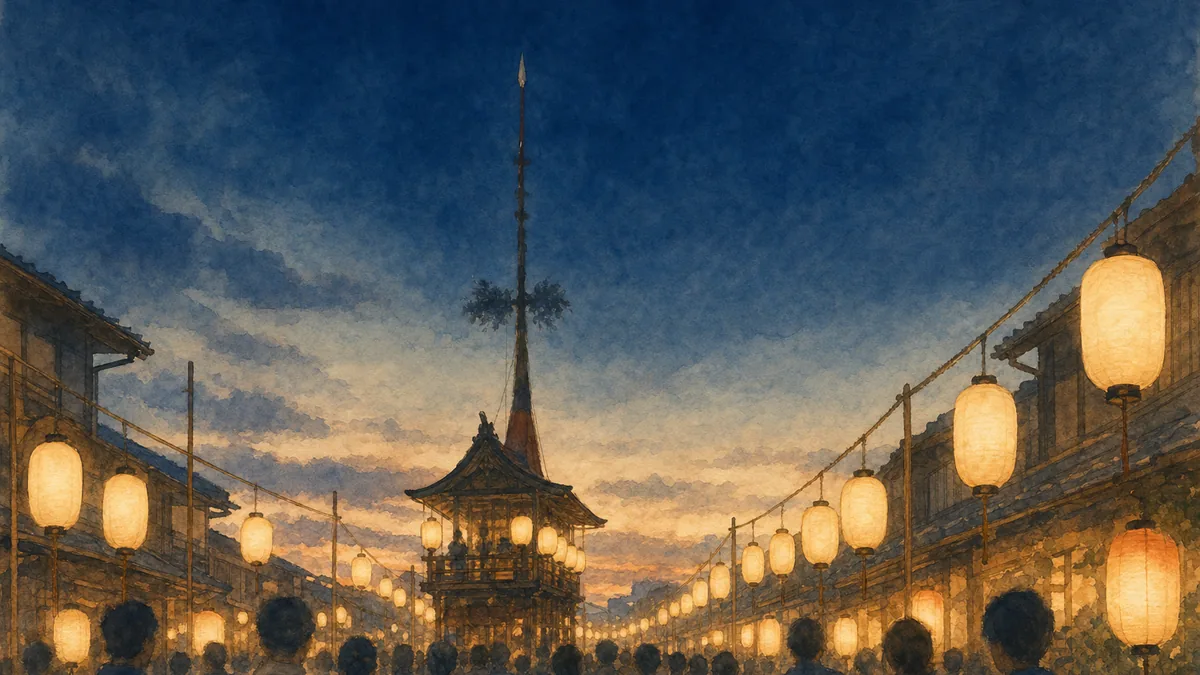
Gion Matsuri is a month, not a night
Gion Matsuri is the festival of Yasaka Shrine in Kyoto, and it has been held in some form for more than a thousand years. The part everyone pictures — tall wooden floats gliding through the streets — is real, but it is two mornings out of a calendar that fills the whole of July.
There are two peaks. The Saki Matsuri, the "former festival," builds to its grand procession, the Yamahoko Junko, on July 17. The Ato Matsuri, the "latter festival," holds its own smaller procession on July 24 — 23 floats go out on the 17th against 11 on the 24th, which is most of the difference in feel. Each is preceded by yoiyama, the festival eves: July 14 to 16 before the 17th, and July 21 to 23 before the 24th. Those are calendar dates, not "the third weekend" — they fall on whatever weekday the year hands them, so check which day of the week the 17th actually is before you book around it.
The two peaks do not feel the same. On the saki-matsuri yoiyama evenings, the central streets around Shijo and Karasuma have in recent years been closed to traffic and turned into pedestrian zones packed with food stalls and crowds — but which streets close, and for which hours, is set year by year, so read the current year's traffic notices rather than last year's map. The ato-matsuri evenings a week later are noticeably calmer: fewer stalls, more room to breathe, the same floats without the crush.
That shape decides which nights are expensive and which are close to ordinary. Treating all of July as one undifferentiated "festival" is how people overpay for the wrong dates.
What the festival does to the room you booked
Around the two peaks, and especially the nights before the 17th, the hotels inside the festival core tend to sell out months ahead. Rates climb, and the friendly cancellation terms you rely on the rest of the year tend to harden.
Read the cancellation line before anything else. In peak weeks I saw a lot of "festival rate" bookings that were fully prepaid and non-refundable — a fine deal if your plans are certain, an expensive one if they are not. The 2 a.m. version of you, whose flight was delayed and who now cannot get the money back, reads that line closely; read it first instead. I am not going to promise what any hotel's policy is, or whether a refund is possible — that varies by property and rate, so confirm the current terms on the official booking page.
The other classic is the guest who booked "Kyoto" that turned out to be an hour away. The listing said Kyoto, the price was suspiciously reasonable for July, and the nearest station was somewhere the last train reached long after the parade crowds had scattered. It is the same trap that catches people on any late arrival, the one I wrote about in the first hours after a late landing: the address on the booking is not the address in your head.
If the core is full, or brutal on price, treat distance as a strategy rather than a defeat:
- Osaka. Frequent trains connect Osaka and Kyoto. The fastest JR service runs the two stations in about 28 minutes and leaves every 15 minutes through the day; slower JR services and the private lines take longer. Verify the actual timetable for your own stations and date, because "about" is carrying weight there.
- Otsu. Just over the prefecture line in Shiga, Otsu sits two stops from Kyoto Station on the JR main line, with Yamashina in between — about ten kilometres of track, close enough to sleep outside the crush and commute in, though again, confirm the current timetable.
- Near Kyoto Station. Not the festival core, but a short hop from it, with more rooms, more 24-hour front desks, and a much easier last leg home at night.
None of these is a consolation prize; on the busiest nights they are often the calmer, cheaper choice. And if the trade-off is a machiya inn in the core versus a plainer room with a staffed desk, the ryokan-versus-hotel comparison is worth reading first.
The 2 a.m. lobby test, festival edition
Now run the test properly. The festival changes the walk from "I have a reservation" to "I am asleep."
The streets close, and taxis cannot follow
On the yoiyama evenings, when the central streets become pedestrian zones, a taxi cannot deliver you to a door inside the closed area. It stops at the edge, and you walk the rest with your bag. That is fine if you planned for it: arrive before the streets close, or know where the car has to stop. Which streets, and which hours, is a current-year detail — check the traffic notice, not your memory.
Know your check-in cut-off
A large or business hotel near the station usually keeps a 24-hour desk, and a 1 a.m. arrival is nothing to it. A small guesthouse or a machiya inn often locks the door and sends the last staff member home at ten or eleven. Turn up after that on a festival night, phone dead and streets rearranged, and there may be nobody to hand you a key. The fix is one message before you travel: tell the property your arrival time and ask what happens if you are late.
The last train is earlier than the party
If you are sleeping in Osaka and spending the evening at the festival, the crowd will still be thick when your last train home is getting ready to leave. Trains back toward Osaka generally stop running before midnight, not at it — and "before midnight" is not a timetable either, so look up the actual last departure for your line and date. Missing it on a normal night is an inconvenience; missing it on a festival night, when taxis are scarce and the streets are full, is an expensive one.
Luggage on parade morning
If you are checking out on the 17th or the 24th, your suitcase and the procession want the same streets, and moving a large case through parade-day crowds is miserable. Sending it ahead by luggage forwarding, or leaving it in a station locker for the day, are the usual ways around it — I cannot promise a locker will be free or that forwarding will fit your timing, so arrange and confirm both in advance. Why the station map lies about moving a bag is its own subject in the luggage-logistics guide.
The heat is part of the plan
One more thing the noon version of you underestimates: July in Kyoto is genuinely hot. The average daily high for the month is about 32°C, the hottest days push past 35°C, and the humidity makes all of it feel heavier still. Evenings are cooler, but a dense crowd holds the warmth in. Carry water, pace yourself, and build in places to sit down. On a festival night the heat is not a mood — it is a logistics item, the same as the last train.
Everyone in the group needs a working phone
The festival rarely goes wrong by the whole group getting lost at once. It goes wrong when one person goes quiet because their phone died in the crowd — and on a yoiyama night, with the streets rearranged and a very large number of people between you, "we'll just meet at the corner" stops being a plan.
So the connectivity advice stands on its own: download the area map offline, agree on a fixed meeting point and a fallback time, screenshot the last-train departures, and make sure everyone can pull up the route. If your group is carrying several phones and tablets that all need to stay online at once, a rented pocket WiFi unit is one option to compare against local SIMs and eSIMs; check the current terms yourself before you commit.
Before you book: the festival checklist
Back to the lobby, and the suitcase by the doors. The fix was never heroic — a handful of things the noon version of the guest could have checked in ten minutes and didn't. Run them before you pay:
- Book the month, not the night. Decide whether you want the peak — the crush before the 17th — or the calmer ato-matsuri days around the 24th, and price your dates accordingly.
- Read the cancellation line first. Assume a festival-period rate may be non-refundable until you have confirmed otherwise on the official page.
- Arrive before the streets close. On yoiyama evenings, reach the door before the pedestrian zones go up, or know where the taxi has to stop.
- Know your check-in cut-off. Confirm the desk hours, and send a small property your arrival time in advance.
- Look up your actual last train. "Before midnight" is not a timetable — check the real last departure for your line and date.
- Carry water. Low-30s heat and a dense crowd is a thing you hydrate for, not a surprise.
Do that, and the 2 a.m. version of you walks into a lobby that is expecting you, with a phone that still works and a route you already know. The floats will still be extraordinary. You will simply be rested enough to enjoy them — which, after a thousand years, is the least the festival owes you.
References
- Kyoto City Official Travel Guide (official) — Gion Matsuri Festival: procession dates (July 17 / July 24), float counts (23 / 11), and yoiyama dates (July 14–16 / July 21–23): kyoto.travel/en/travel-inspiration/gion-matsuri-festival/
- Japan Meteorological Agency — Kyoto climate normals (1991–2020): July mean daily maximum 32.0°C: data.jma.go.jp — 京都 平年値
- Wikipedia — JR Kyoto Line: Special Rapid service, Kyoto–Osaka in 28 minutes, every 15 minutes in the daytime: en.wikipedia.org/wiki/JR_Kyoto_Line
- Wikipedia — Ōtsu Station / Yamashina Station: station order Kyoto (JR-A31) – Yamashina (JR-A30) – Ōtsu (JR-A29), 5.5 km + 4.5 km: ja.wikipedia.org — 大津駅
- Yasaka Shrine — home of Gion Matsuri (official site): yasaka-jinja.or.jp
- Japan National Tourism Organization — trip planning: japan.travel/en/