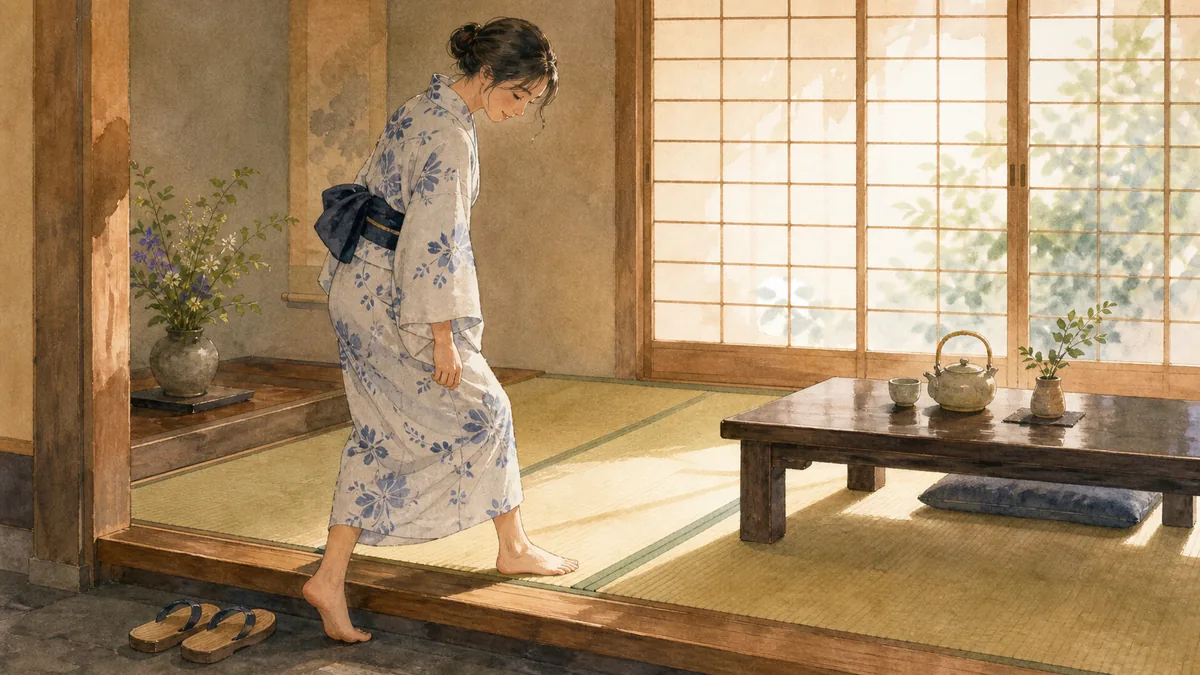
Shoes Off at the Genkan
The etiquette starts before anyone's even said hello. Just inside the entrance of most ryokan is a sunken area called the genkan, set a step below the main floor, where outdoor shoes come off. The height of that step varies a lot between buildings — sometimes it is barely a lip, sometimes a proper stride up. Stand in the genkan, remove your shoes, then step up onto the raised floor in socks or bare feet. Staff will often have a pair of house slippers waiting for you right there.
Those slippers are for hallways, stairs, and shared spaces. They are not for tatami. The moment you're heading into a tatami room — your own or anyone else's — the slippers come off too, left at the doorway. It sounds like a lot of shoe management for one lobby, but you'll pick up the rhythm after the first switch. If you forget and start to shuffle onto tatami with slippers on, staff will usually just point kindly at your feet. Nobody is silently judging you; they've seen it a hundred times before.
One smaller point: try not to step directly on the raised threshold strip between rooms, the wooden or fabric-edged bar at floor level. It's a minor point of traditional house etiquette rather than a hard rule, and no one will stop you mid-stride if you do, but stepping over it instead of on it is the polite habit.
Settling Into Your Room
Tatami mats are woven rush grass over a firm base, and they mark more easily than carpet — a dragged suitcase wheel or a dropped umbrella can leave a dent. Most ryokan will have already brought your bags in for you, but if you're moving anything yourself, lift rather than drag it across the floor.
The low table in the middle of the room is where tea gets poured when you arrive and where breakfast is sometimes served the next morning. Sitting on the floor cushions around it however is comfortable for you is fine; there's no strict posture requirement for guests, whatever period dramas might suggest.
You'll likely also spot a small alcove in one corner with a hanging scroll, a flower arrangement, or a piece of pottery. That's the tokonoma, and it's treated as a slightly formal display space rather than extra storage. Resist the urge to set your suitcase, phone charger, or snacks in it, even though the empty floor space is tempting. It's the one corner of the room that's decorative rather than functional.
Wearing Your Yukata (Without Looking Like You Just Woke Up)
The cotton robe folded on your bed or in your room is a yukata, and it doubles as loungewear, sleepwear, and, at many ryokan, acceptable dinner attire and a walking-around-town outfit. Wearing it is genuinely part of the experience, not just a courtesy gesture.
One rule matters more than the rest: wrap the left side over the right. Right-over-left is how the deceased are dressed for funerals, so getting this backwards reads as more than a wardrobe slip to Japanese eyes — it can visibly unsettle people. Put your arms through the sleeves, bring the right side across your body first, then fold the left side on top of it, and tie the obi, the fabric belt, around your waist. If the whole thing feels loose or keeps dragging on the floor, ask staff to help adjust it. They will not think less of you for asking; it happens constantly with first-time guests.
Most ryokan are fine with you wearing your yukata to the dining room, down to the bath, and around the building in general. A few higher-end properties prefer regular clothes at dinner, so if you're unsure, a quick glance at what other guests are wearing in the hallway will usually answer the question for you.
How the Bath Actually Works
The onsen, or communal bath, is where first-timers worry the most, and it's also where the etiquette is the most consistent from place to place. Here's the order of operations: undress fully in the changing room, bring only the small hand towel you're given into the bathing area, sit at one of the low washing stations, and wash and rinse thoroughly before going anywhere near the tub. Shampoo, soap, rinse, all of it, seated, before you enter the water. The bath itself is for soaking, not for scrubbing.
That small towel can cover you for modesty on the walk over, but it never goes into the bathing water itself. Most guests fold it and set it on the edge of the tub or balance it on top of their head. Swimwear isn't part of the picture at a traditional onsen — you go in as you are — and if you have long hair, tie it up so it stays clear of the water.
One practical note worth knowing: onsen water tends to run hot, sometimes hotter than a typical home bath, and combining that heat with alcohol or dehydration is a genuinely bad mix. Drink some water beforehand, skip the bath right after a few drinks, and get out if you start feeling lightheaded. Most soaks are completely uneventful and very relaxing — this is just worth being aware of rather than worrying over.
A Word About Tattoos
Some onsen still restrict visible tattoos, and the rule varies a lot by property rather than being universal. The background is older and blunter than most travellers assume: Japan's tourism board explains that tattooing was once used by the government itself to punish and keep track of criminals, and that this history left tattoos partially associated with criminality long after the practice was abandoned. Japan's own tourism agency, writing to the hotel and ryokan industry associations, put it more carefully still — that attitudes to tattoos differ culturally, that a single universal standard would be difficult to set, and that refusing someone entry solely because they have a tattoo is not appropriate. The same guidance lists the workarounds properties are encouraged to consider: covering the tattoo with a sticker or patch, asking nothing extra when a tattoo is small — palm-sized is the example given — steering guests toward quieter hours, or pointing them to a private or room-attached bath. If this applies to you, it's worth checking a ryokan's policy, or asking Tokyo Inn, before you book rather than finding out at the changing room door. It's a real consideration, but not one that should keep you from a ryokan stay — private baths in particular make it a non-issue.
Dinner: Kaiseki Timing and Table Manners
Many ryokan serve dinner as kaiseki, a multi-course meal where dishes arrive one at a time, each timed to be eaten shortly after it's placed in front of you rather than left to sit. Staff usually ask you to confirm a dinner time at check-in, and showing up close to that window matters more here than at a regular restaurant, since the kitchen is often cooking each course to that exact moment.
If dinner is served in your own room, staff will come and go to bring each course and clear the last one; there's no need to stack your own dishes or tidy up before they arrive. Slippers come off before you step onto the tatami where the meal is laid out, same as everywhere else in the room. Beyond that, the usual quiet good manners apply: try a bit of everything if you can, and don't feel obligated to finish dishes you genuinely don't enjoy. No one is tracking your plate.
Futon, Bedtime, and Not Panicking About the "Missing" Bed
If you walk into your room after dinner and there's no bed, that's completely normal, not a mix-up. In many ryokan, staff lay out the futon while you're at dinner or in the bath, turning the same tatami room that held your low table into a bedroom for the night. It usually reappears as a table again once the bedding is put away in the morning.
- The futon is a padded mattress and a duvet-style cover laid directly on the tatami, which surprises some guests expecting a raised bed frame.
- It's worth trying with an open mind; a lot of travelers find it more comfortable than expected, and a few genuinely don't.
- Either way, you don't need to do anything with it yourself — laying it out and putting it away is staff's job, not a guest task.
Onsen Towns, Tipping, and Checking Out
If your ryokan sits in a hot spring town, wandering the streets in your yukata and the wooden sandals provided is completely normal and, honestly, half the fun. You'll see plenty of other guests doing exactly the same thing in the evening. Keep your voice down near the baths and in the halls at night, since ryokan rooms tend to sit closer together than hotel rooms and sound travels through the walls.
Tipping isn't expected in Japan, ryokan included, and trying to leave cash for staff can create an awkward moment of them trying to hand it back to you. If you want to show appreciation, a sincere thank-you at checkout does the job. Checkout itself is usually simple and handled at the front desk, often with the same warmth you got at arrival; ask about luggage storage if you're heading somewhere else for the day, since most ryokan are happy to hold bags after checkout.
None of this is really about rules for their own sake. It's the same as settling into any new place: a handful of habits that click after the first evening, and staff who'd rather help you than watch you get something wrong. If you're still weighing whether a ryokan or a business hotel fits your trip, or want a sense of ryokan experiences other travelers loved, those are good next reads. Otherwise: pack light, keep an open mind about sleeping on the floor, and you'll be fine.
Sources
- Japan National Tourism Organization — How to Best Enjoy Japan's Onsen: undress fully in the changing area, wash and rinse completely at a washing station before entering, and keep the small towel and long hair out of the water. Accessed 2026-08-01.
- Japan Tourism Agency / Ministry of Health, Labour and Welfare — 入れ墨(タトゥー)がある外国人旅行者の入浴に関する対応について (notice to hotel and ryokan industry associations, 16 March 2016; circulated to prefectures 18 March 2016; PDF). States that refusing bathing solely on the basis of a tattoo is not appropriate, that a single uniform standard is difficult to set, and lists the response examples: covering the tattoo with a sticker, requiring nothing special for a small (palm-sized) tattoo, suggesting quieter hours, and offering a private or room-attached bath. Accessed 2026-08-01.
- Japan National Tourism Organization — Onsen Hot Springs: On Tattoos and Etiquette: "tattooing was actually used by the Japanese government as a means of punishing and keeping tabs on criminals… historically, this has meant that tattoos have partially been associated with criminality." Accessed 2026-08-01.
- Visit Kinosaki — Taking a Japanese Bath: rinse the stool and remain seated while washing, rinse off all soap before entering, and tie up long hair. Accessed 2026-08-01.
- Visit Kinosaki — How to Wear a Yukata: "Then wrap the left side over the right"; and "Do not cross the right side of the yukata above the left. This is how Japanese traditionally dress the dead in yukata." Accessed 2026-08-01.
- Japan Guide — How to Stay at a Ryokan: Dress (Yukata): "Fold the right hand side underneath the left hand side… Now fold the left hand over the right hand side," then secure with the obi. Accessed 2026-08-01.