You slide your shoes off in the entryway before anyone tells you to, because the floor changes underneath you and your feet make the decision on their own: polished wood, then a step up, then tatami, and everything gets quieter from there. Someone appears with barley tea and a small sweet on a paper mat before you've said a word about the train ride. It is roughly the tenth time all week you've taken your shoes off to enter a building. It is the first time it has felt like being received rather than processed.
What follows is not a scorecard, and no individual ryokan appears in it by name. Central Tokyo itself has very few true ryokan — most sit an hour or more outside the city, in hot-spring towns built around exactly this kind of stay — so ranking specific properties would mostly be ranking places you'd take a day trip or a weekend to reach, not a Tokyo neighborhood. This list ranks the experience instead: the individual pieces of a ryokan stay that, in our own editorial read of what first-time foreign guests keep describing after they get home, land hardest. It's the Tokyo Inn team's judgment, drawn from patterns we notice — not a review-score table, not an industry ranking, and not anyone's final word but ours. No inn paid for a position on this list, because no inn is named on it.
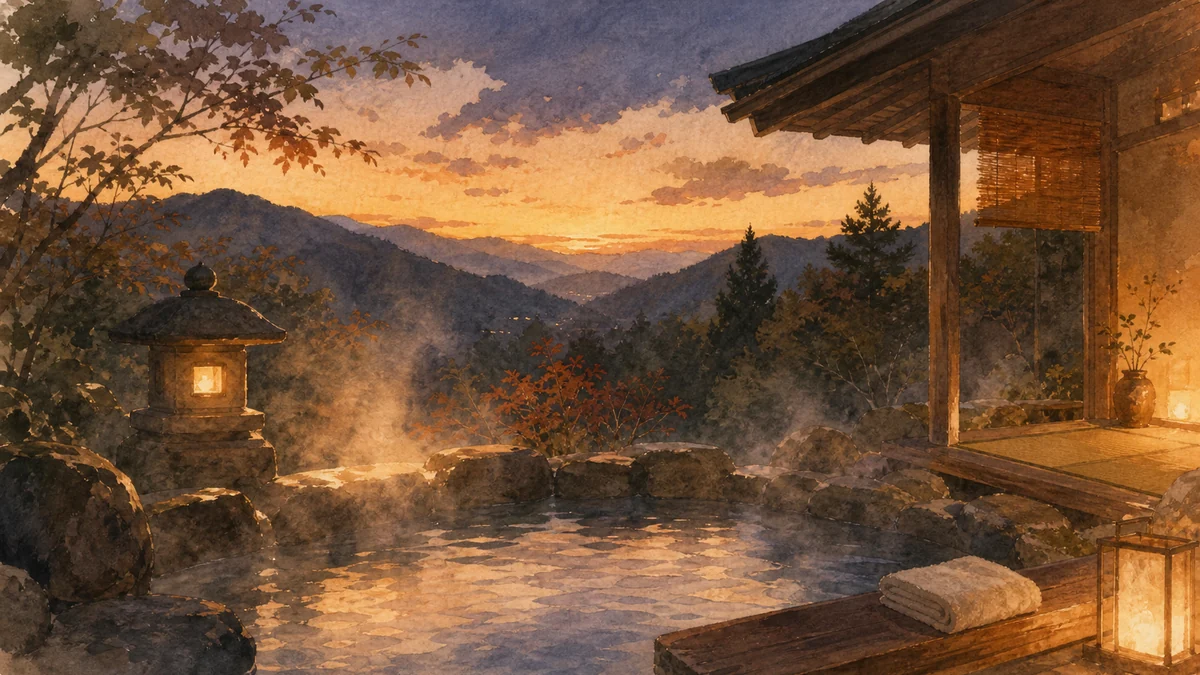
1. The open-air bath — onsen with the roof taken off
A rotenburo is a hot-spring bath outdoors, and the appeal is almost embarrassingly simple: heat on your skin, cold air on your face, and nothing manufactured about either. Steam sits low over the water and doesn't dissipate the way it would indoors, because there's no fan pulling it away and no ceiling for it to hit. Depending on the property, you're looking at pine trees, a river gorge, or just the dark. None of that needs embellishing. It's the one part of a ryokan stay that guests reliably describe as the reason they'd go back.
The etiquette is fixed and non-negotiable: wash and rinse completely at the stool provided before you get in, and don't let your towel touch the water. Tattoo policies vary by property — some prohibit them outright in shared baths, some allow them with a cover, and some don't mind at all — so it's worth checking in advance if it applies to you, rather than finding out at the changing-room door.
If a shared bath's tattoo policy is a problem, it usually isn't the end of the onsen experience — it's a reason to look at item 7 below. Many ryokan that restrict tattoos in the communal bath still rent out a private one by the hour.
2. Dinner that arrives as a sequence, not a menu
Kaiseki is a multi-course Japanese dinner built around what's seasonal, and at a ryokan it usually shows up in your room or a private dining space rather than a restaurant hall — some inns do serve it in a communal dining room, so it's worth checking which one you've booked. You stop checking a menu at some point, because there isn't one to check against — a dish appears, you eat it, and the next one comes when the kitchen decides it's ready. Small bowls, a course grilled tableside, something pickled, something you can't quite name and don't mind not being able to.
It runs on the inn's clock, not yours: dinner starts at a set time, and eating out beforehand tends to defeat the purpose. If you have dietary restrictions, say so when you book rather than when you sit down — most kitchens can accommodate a stated restriction with notice; almost none can improvise one at the table.
3. Sleeping in a room that changes shape for the night
The room you have dinner in is not the room you sleep in, even though it's the same four walls. While you're eating, someone comes in and lays out a futon on the tatami, and by the time you're back it looks like an entirely different space — low and soft where it was open and bare an hour earlier. There's a particular smell to a tatami room, grassy and a little sweet, from the woven rush mats themselves, and it's one of those details guests mention long after they've forgotten the name of the town they stayed in.
Sleeping close to the floor takes most Western guests one night to adjust to and roughly zero effort after that. It isn't a hard futon on a hard floor — it's a padded one on a springy tatami surface, which is a gentler landing than it sounds from the outside.
4. The Japanese breakfast
Dinner gets the attention, but the breakfast is where a lot of guests admit they were quietly won over. It's a tray, not a buffet: grilled fish, rice, a bowl of miso soup, a few small dishes of pickles and simmered vegetables, sometimes a soft-cooked or raw egg to mix into the rice. Nothing about it is trying to impress you in the way the previous night's dinner was — it's just a well-made, savory meal at a fixed hour, and after a week of hotel buffets it tends to stand out precisely because it isn't performing.
5. Wearing yukata
The inn hands you a yukata at check-in, and for the length of the stay it's what you wear — to the bath, to dinner, down the hallway, sometimes out into the streets of the onsen town itself. There's one piece of etiquette worth knowing before an attendant has to correct you: the left side wraps over the right. The reverse — right over left — is reserved for dressing the dead, so it isn't a small detail to get backward.
Guests tend to describe this less as costume and more as permission: for one evening, the schedule loosens and the clothing does too.
6. Omotenashi — the host who anticipates rather than reacts
Omotenashi is usually translated as "hospitality," which undersells it. What guests actually notice is the anticipation: tea appears before you ask, the futon is ready before you're tired enough to want it, a nakai or okami seems to know your dinner timing and your morning train without either being discussed at length. It isn't intrusive — it's closer to being looked after by someone who has simply paid closer attention than you expected anyone to.
Tipping isn't the mechanism here and isn't expected; a genuine thank-you at checkout covers it. The care is the point, not a transaction layered on top of it.
7. A private bath you can reserve for yourself
Kashikiri-buro — a small private bath booked in a time slot, usually through the front desk — solves for exactly the situations the communal bath doesn't: couples who want to soak together, families with young kids, guests who are shy about a shared bath, and guests whose tattoos rule out the shared one entirely. It's smaller than the main bath and often plainer, but the appeal isn't the view — it's having the whole thing to yourself for the better part of an hour, no negotiation required.
8. The room that asks you to slow down
Shoji screens filter the light instead of blocking it. An engawa — a narrow wooden veranda — sits between the room and whatever's outside, whether that's a tended garden, a mountainside, or just trees. There's usually nowhere obvious to put a laptop, which turns out to be the point rather than an oversight: a ryokan room isn't designed around a desk, so it doesn't invite you to keep working in it. Guests who arrive intending to check email between activities often report losing that intention somewhere around the second hour — the closest thing to an actual "digital detox" that a hotel room rarely manages to produce by accident.
9. The onsen town itself, moving at the same slow pace
A ryokan rarely stands alone. It sits in a town built around the same hot springs, and the whole place tends to keep the inn's unhurried rhythm: footbaths (ashiyu) where you can soak your feet for free on a public bench, geta sandals clacking on the pavement after dark, old wooden inn facades lit from within. Hakone, Kusatsu, Nikko, Kinosaki — scattered across the country rather than clustered around Tokyo, and reached in anything from an hour to most of a travel day, but the same basic shape of an evening: yukata-clad guests strolling between the inn and a shop or a shrine, in no particular hurry to be anywhere else.
The list, side by side
| Experience | What travelers respond to | A practical heads-up |
|---|---|---|
| Open-air onsen | Hot water outdoors, no artifice about it | Wash fully before entering; tattoo rules vary by inn |
| Kaiseki dinner | A meal that unfolds rather than gets ordered | Fixed serving time; flag dietary needs at booking |
| Futon on tatami | The same room, transformed while you were at dinner | Staff usually lay it out — no need to ask |
| Japanese breakfast | Savory and unhurried, unlike a hotel buffet | Also runs on a fixed time, often tighter than dinner |
| Yukata | Wearing the inn instead of just staying in it | Left side wraps over right, not the reverse |
| Omotenashi | Care that anticipates rather than responds | Tipping isn't the custom; a sincere thank-you is |
| Kashikiri-buro (private bath) | A soak with none of the shared bath's constraints | Usually booked at the front desk, in timed slots |
| Architecture & garden | A room with nowhere convenient to keep working | Best appreciated by staying in for an evening, not out |
| Onsen-town atmosphere | A whole town keeping the same slow pace | Most walkable in yukata and geta after dark |
Specific inns, room availability, and rates move constantly and vary widely by property, region, and season. When something on this list calls to you, treat it as a starting point — check current details directly with a booking platform or the property itself before you commit.
References
- Japan National Tourism Organization — Japanese ryokan guide: japan.travel/en/guide/japanese-ryokan/
- Japan National Tourism Organization — how to best enjoy an onsen (bathing manners: wash and rinse fully at the washing stations before entering, keep towels and hair out of the water, check tattoo policies in advance): japan.travel/en/guide/how-to-best-enjoy-onsen/
- Japan National Tourism Organization — tipping in Japan ("it's not common to tip for services such as those provided in bars, cafes, restaurants, taxis, and hotels"): japan.travel/en/plan/tipping-in-japan/
- Japan Ryokan Association — Okami, the traditional manager of a ryokan (okami and the room maid/attendant, nakai-san): ryokan.or.jp/past/english/okami/
- Japan National Tourism Organization — trip planning: japan.travel/en/plan/