If you have a tattoo, you have probably already found the warning somewhere in your research: some onsen and public baths in Japan don't allow them. That warning is true, and it's also incomplete. It leaves out the part that actually matters to you, which is that you have several real, workable options, and none of them require you to skip the bath experience or spend your first night in Japan anxious about a front-desk conversation. This is the boring, practical version of that warning — the one with a plan attached.
We'll define one term as we go: an onsen is a bath fed by a natural hot spring. You'll also see sento, a public bathhouse using regular heated water, and hotel or day-spa baths, which are a separate category again. The tattoo policy at each of these can be different, and knowing why helps you plan around it instead of guessing.
Why some baths restrict tattoos, in plain terms
The short version: it's a house rule at individual facilities, not a national law. Neither the Public Bath Houses Act nor the Hot Springs Act says anything about tattoos — the first defines a public bath as premises where the public bathes using hot water, sea water or hot-spring water; the second defines a hot spring by its source and its temperature or mineral content. Nothing in either gives a facility a legal reason to refuse you. The rule is the operator's own.
Where it comes from is documented. Japan's Tourism Agency, in its own visitor Q&A about staying at a ryokan, puts it plainly: tattoos in Japan call to mind members of antisocial organisations, and inns have historically declined to admit tattooed guests to the baths so as not to unsettle other guests. The association runs further back, too. JNTO's account notes that tattooing was once used by the Japanese government to punish and keep track of criminals, and that those marked took to decorating and disguising the results — a history that left the mark carrying a stigma long after the official practice was abandoned. Many bathhouses adopted a no-tattoo policy decades ago on that basis, and some still keep it today, sometimes out of habit as much as active concern. There's also a general etiquette layer around shared bathing — communal baths in Japan run on an unwritten expectation that everyone in the water is, in a sense, keeping things calm and unremarkable for everyone else, and a visible tattoo has historically read as a break from that.
None of this means every bath in Japan is closed to you, and it doesn't mean the rule is applied the same way everywhere. It varies a lot — by region, by the type of facility, by how the tattoo looks, and sometimes by the mood of the person at the front desk that day. Tourist-oriented areas and larger facilities tend to be more relaxed than a small neighborhood sento. Treat "some baths restrict tattoos" as a true but very general statement, not a rule that applies uniformly to your specific situation. The next sections are about narrowing that down to something you can actually plan around.
Step 1: Book a private bath — the lowest-stress route
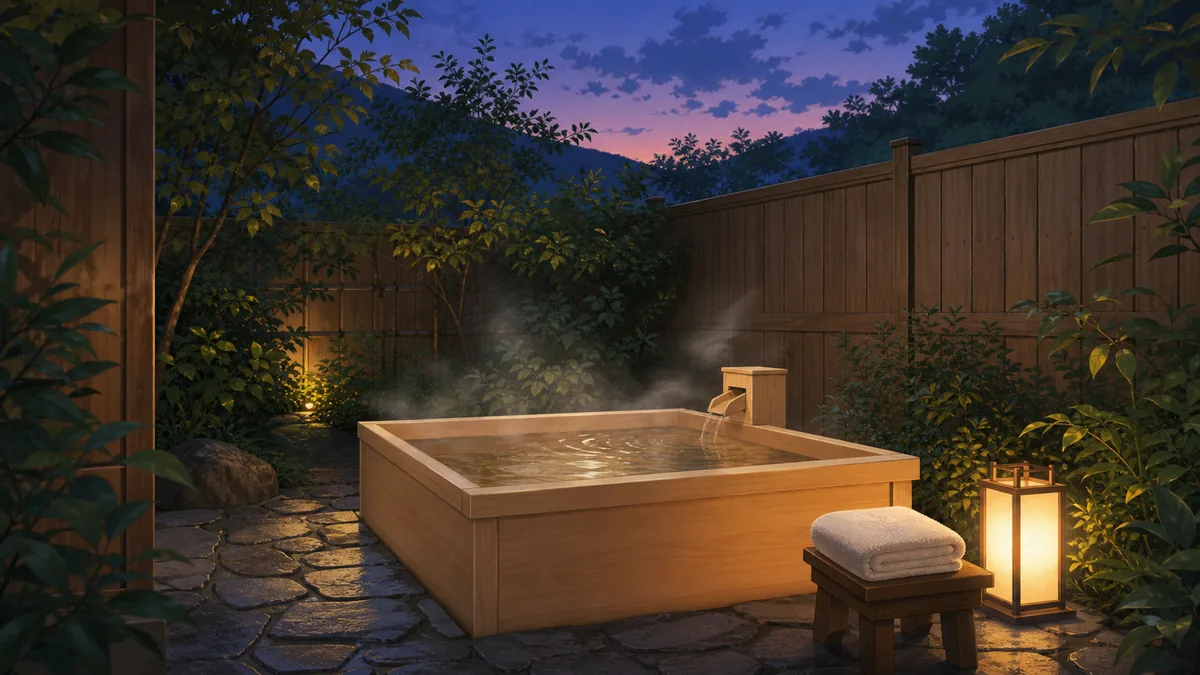
This is the option we'd point almost anyone toward first, because it sidesteps the whole question. If you bathe alone or with your own group, in a bath no one else is sharing, a tattoo simply isn't a factor. Nobody is evaluating you against a house rule, because there's no shared room to have a rule about.
Two versions of this are common in Japan:
- Kashikiri (貸切風呂) — a private bath you reserve for a set time slot, just for your party. Slots at the properties we checked ran 45 to 60 minutes; assume something in that range and confirm with the property. Many ryokan (traditional inns) and some larger hotels offer this, sometimes included with your stay and sometimes booked as an add-on for a separate fee.
- In-room open-air bath (露天風呂付き客室) — a private outdoor-style bath attached directly to your room. This is more of a ryokan feature, and it tends to appear in higher-end properties, but it exists across a range of price points too.
If a private bath matters to you, it's worth making it a filter when you're choosing where to stay, not an afterthought once you arrive. When you're comparing a ryokan stay against a hotel stay, this is one of the practical differences worth weighing — for more on that comparison, see our guide to choosing a ryokan vs. a hotel in Japan. Availability and pricing for kashikiri or in-room baths vary by property and by season, so confirm directly with the place you're booking rather than assuming a feature applies to every room type.
Step 2: Consider a cover-up for smaller tattoos
If your tattoo is small enough to cover, skin-tone cover stickers or patches are a genuinely common workaround. JNTO's own guidance points to three places to get them: some onsen sell them at the facility, they are easy to buy online before you travel, and the discount chain Don Quijote stocks them. They're designed to blend with skin tone and stay on in water for a reasonable soak.
A few honest caveats:
- They work best on tattoos roughly the size of a palm or smaller. A full sleeve or back piece isn't realistically coverable this way.
- Even with a cover applied, a facility is still allowed to say no — a cover reduces the chance of a problem, it doesn't guarantee entry. If a policy is strict about tattoos generally, staff may still decline once they know one is underneath.
- Ask before you rely on this. If a specific onsen or sento matters to you, a quick message asking "is a covered tattoo acceptable?" before you go saves you an awkward moment at the entrance.
This is a good middle option when a private bath isn't available or isn't in your budget, but it's a mitigation, not a guarantee.
Step 3: Look for tattoo-friendly facilities directly
Enough baths in Japan are explicitly tattoo-friendly that dedicated directories exist to list them: Tattoo Friendly (tattoo-friendly.jp) is a bilingual location finder covering onsen, sento, hotels and ryokan, and it is the one we'd start with. Whether the number is rising is harder to state than you'd think. JNTO says attitudes are shifting and that the count is increasing, and Japan's Tourism Agency notes that understanding has been growing among inns — but neither publishes a figure or a comparison over time, so treat the direction as reported rather than measured. As a category, you'll generally have better odds at:
- Large day-spa "super sento" facilities — bigger operations, often with multiple bath types and a more tourist-accustomed clientele, tend to be more relaxed than a small local bathhouse.
- Ryokan that emphasize private bathing — properties built around kashikiri or in-room baths often don't have a shared-bath tattoo issue to begin with, for the reasons in Step 1.
- Certain regions and tourist hubs — areas that see heavy international visitor traffic have, in general, adapted policies faster than more local, less-touristed areas. This is a broad tendency, not a rule you can rely on for any one address.
Here's the important habit to build: treat any list you find — including this one — as a starting point, not a guarantee. Policies change, ownership changes, and a list compiled a year or two ago can be out of date. Before you build a plan around a specific facility, confirm its current policy directly, using the toolkit below.
Step 4: Understand why policy differs between onsen, sento, and hotel baths
It helps to know that "Japanese bath" isn't one category with one rule:
- Onsen (温泉) — natural hot-spring baths, found at ryokan, dedicated bathhouses, and resort facilities. Policy varies widely here, from strict no-tattoo rules at some traditional facilities to fully welcoming policies at others.
- Sento (銭湯) — neighborhood public bathhouses using regular hot water rather than a hot spring. These are often smaller, more local, and can lean more traditional in their rules, though this isn't universal.
- Hotel and day-spa baths — baths attached to city hotels or standalone spa facilities. These skew more accustomed to a mixed, international clientele, especially in major cities, though individual policy still varies by property.
None of these categories guarantees an outcome on its own — they're a rough guide to where your odds are better or worse, not a substitute for checking the specific place you're considering.
A simple toolkit for asking politely
Confirming tattoo policy in advance is a small, low-stakes step, and it removes almost all of the anxiety around this whole topic. Here's how to do it without overthinking it:
- Check the property's own booking page or website first. Many ryokan and hotels state their tattoo policy directly, sometimes under a "facilities" or "FAQ" section.
- Send a short message before you book or before you go. A simple line works well: "Do you have any restrictions on visible tattoos in the bath?" Keep it brief and neutral — this is a routine question for front-desk and reservation staff, not an unusual one.
- If you're already booked and unsure, ask at check-in rather than at the bath entrance. It's easier for staff to point you to a private bath option or explain the policy calmly at the front desk than in the changing room.
- Have a fallback ready. If a specific bath says no, your fallback is Step 1 — ask whether the property has a private or reservable bath instead. Many do, even ones with a shared-bath tattoo restriction.
One more small thing worth knowing: this question rarely surprises staff. Tattoo policy is something Japanese hospitality workers field regularly from international guests, and asking directly is a completely normal part of planning a stay — not something to feel awkward about.
A reassuring close
Having a tattoo doesn't mean choosing between "skip the onsen experience" and "risk an awkward refusal." In practice, most visitors in this situation land on one of three outcomes: they book a private bath and the question never comes up, they find a facility that's genuinely tattoo-friendly and confirmed as such, or they cover a smaller tattoo and check ahead. All three are ordinary, low-drama choices once you know they exist.
Once you've settled the bath question, the rest of the visit is just etiquette — how to wash before soaking, how to wear a yukata, what to do with your towel. That part is covered separately in our full walkthrough, so you can treat this tattoo question as its own settled step and move on to the rest of your planning with one less thing to worry about. See our ryokan and onsen etiquette guide for that next step.
Sources
- JNTO Travel Japan — Onsen Hot Springs: On Tattoos and Etiquette. Accessed 2026-07-18.
- Tattoo Friendly — location finder for tattoo-friendly onsen, sento, and hotels in Japan. Accessed 2026-07-18.
- Japan Tourism Agency — Ryokan Q&A, Q2 on tattoos and communal baths (origin of the restriction; private and in-room baths as the alternative). Accessed 2026-08-01.
- JNTO — Guide to Bathing in Japan (private kashikiriburo; cover sheets suit only small tattoos). Accessed 2026-08-01.
- e-Gov Laws — Public Bath Houses Act, Article 1 and Hot Springs Act, Article 2 (statutory definitions; neither mentions tattoos). Accessed 2026-08-01.
- Private-bath time slots, checked on property websites: Hanamaki Onsen Airinkan (45 min), Kanouya, Ikaho (45 min), Fuji Lake Hotel (50 and 60 min). Accessed 2026-08-01.