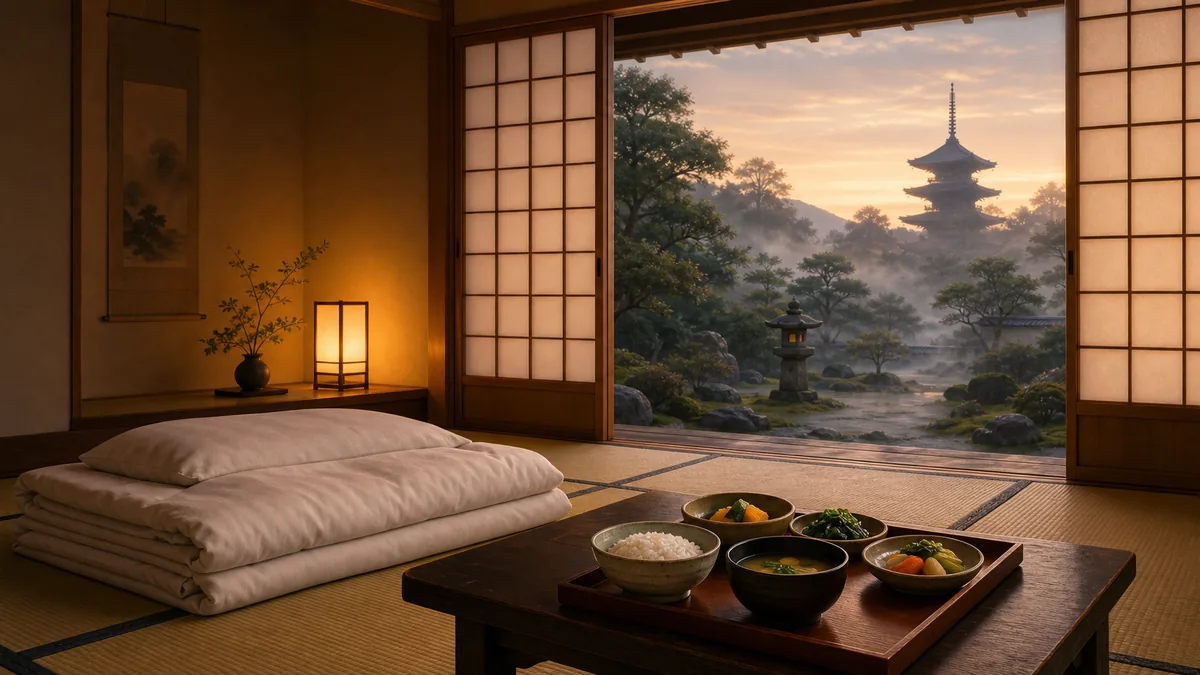
The gate closes at nine, and not in the way a hotel lobby quiets down for the night. It closes because the building has gone back to being what it was before you arrived: a place where people wake before dawn to chant, sweep, and cook for each other, with no interest in whether a guest finds that charming. I've always liked the idea of staying somewhere that isn't performing hospitality for me, and a shukubo — the general term for lodging at a religious site, at Shinto shrines as well as Buddhist temples — is one of the few kinds of accommodation in Japan where that's literally true. This piece is about the Buddhist ones; it is worth knowing that the word covers both, because the shrine lodgings nearest Tokyo are often described in English as temple stays when they are nothing of the kind. You aren't the point of the building. You're a guest inside someone else's discipline for a night, and the best temple stays make no attempt to hide that.
What a Shukubo Actually Is, and Isn't
Shukubo began as lodging for pilgrims walking between sacred sites, a place to sleep partway up a mountain or partway through a circuit of temples, fed and sheltered by the community that lived there. Many temples near Tokyo still function this way first and take overnight guests second. That ordering matters. A themed "temple hotel" built to look monastic, with the incense and the tatami but none of the actual schedule, is a different product and a fair one to book if that's what you want. A working shukubo is not that. Meals happen when the kitchen is ready, not when a guest feels hungry. Lights-out is early because the monks are up again a few hours later. Nobody is going to apologize for the thinness of the futon, and nobody is trying to sell you a spa package while they're at it. The temple's actual work, funerals, memorial services, the daily upkeep of the grounds, keeps going in the background of your stay, sometimes visibly. That's not a flaw in the experience. It's the experience.
An Evening Into a Morning
The shape of a stay is fairly consistent from temple to temple, even though the specifics (start times, whether a particular ritual is offered that night, what's included in the price) vary and are worth confirming directly with the temple before you go. In broad strokes, it runs something like this:
| Part of the stay | What generally happens |
|---|---|
| Late afternoon | Check-in before the main gate closes for the evening; shoes off, luggage left in a simple room. |
| Early evening | Shojin ryori dinner, served at a fixed time rather than on request. |
| Night | Quiet hours, sometimes an optional sutra-copying or meditation session, an early bath. |
| Before dawn | Gongyo — the temple's recitation service, usually open to guests who want to sit in on it. The word covers any of the day's set services, not only the morning one; it is the early one guests are normally invited to, and its form varies by sect. |
| Morning | Breakfast, again vegetarian and simple, followed by a checkout that comes earlier than a hotel's. |
Nobody times this to the minute for you the way a tour itinerary might. You show up, and the temple's day happens around you.
The Food Is the First Lesson
Shojin ryori, the temple's vegetarian cooking, isn't a diet accommodation bolted onto an otherwise ordinary kitchen. It grew directly out of Buddhist precepts against taking life: meat and fish are absent, and so, JNTO notes, are dairy and eggs. Many kitchens also leave out the pungent alliums — garlic, onion, leek, chive, scallion — under the old precept against the "five pungent roots," though this one varies by temple. What remains is tofu, seasonal vegetables, wild mountain plants, and grains prepared with real technique. It reads as minimalist on a menu and eats as anything but. What struck me, thinking back on meals like this, wasn't the absence of meat so much as how little seemed wasted: stems used, broths built from what most kitchens throw out. Portions are modest, and the meal is meant to be eaten with attention rather than conversation. If you've booked expecting a lavish ryokan-style spread, recalibrate; this is closer to a lesson in restraint than a feast.
Meditation and the Brush
Beyond room and board, many shukubo offer some form of practice to guests who want it, and it's usually optional rather than mandatory. Zazen, seated meditation facing a wall or a garden, is the most common. Shakyo, hand-copying a short Buddhist sutra with a brush and ink over a printed guide, is offered at plenty of temples and needs no prior experience; it's less about calligraphy skill than about sitting still long enough to finish something slowly. Some mountain temples add more physical practices, guided early walks, or seasonal rituals involving fire or cold water, though these are temple-specific and not something every shukubo runs on a given night. None of it is a performance staged for guests. You're being allowed to sit in on something the temple already does. Expect brief instructions in simple English or gestures rather than a full explanation of the theology behind any of it; the point seems to be the doing, not the lecture, and a guest who arrives expecting a guided workshop may find the actual pace slower and quieter than that.
Where the Comparison to a Ryokan Ends
A fair amount of the etiquette carries straight over from a traditional inn: shoes off at the entrance, slippers for the corridor and not the tatami room, a set order for using a shared bath, meals that arrive on the house's schedule rather than yours. Our guide to ryokan etiquette covers most of that ground and is worth a read before either kind of stay. Where a shukubo diverges is in how firmly the rules are held. A ryokan will usually bend a little for a tired guest who wants dinner moved back twenty minutes. A temple generally won't, because the schedule isn't built around guests in the first place, it's built around the community's own routine, and you're stepping into it rather than the other way around.
Reachable From Tokyo, Not Remote
Part of what makes a temple stay realistic as a short trip, rather than a pilgrimage requiring days off, is that several options sit within a manageable distance of central Tokyo, even if none of them are a subway ride away. It is worth being precise here, though, because the obvious candidates turn out to be less available than the guidebooks imply.
- Mount Takao, at the western edge of the city, is the closest — a train to the base and then a hike or cable car up to Yakuoin. You can sleep there, but not casually: the temple's overnight programme is a lay practitioners' mountain-ascetic retreat (信徒峰中修行会) held twice a year, in June and October, open to applicants aged 20 and over, capped at forty places and charging ¥25,000. Recent sessions have filled and closed. It is a training course you take part in, not a room you book.
- Chichibu, in Saitama, is threaded with the Chichibu 34 Kannon pilgrimage — thirty-four temples, opened in 1234 according to the pilgrimage association's own history — reached by a combination of train lines and local buses. Neither the association nor the Chichibu tourism body lists shukubo lodging on its site, so treat the circuit as a walking route rather than a place to sleep in a temple.
- The mountains around Ome do have working shukubo, and this is where the English-language shorthand misleads. They sit along the approach to Musashi Mitake Shrine and are run by its Shinto priests — the oshi, hereditary priests who have housed and fed pilgrim associations for generations. Tokyo's own tourism board names two of them as its Tokyo shukubo examples. They are genuinely worth the trip; they are simply not Buddhist monasteries, and a night there is a Shinto one.
- Narita, best known as an airport town, has a substantial temple quarter along the approach to Naritasan Shinshoji, which makes it a good stopover. The temple does not advertise guest lodging, though, so the night itself will be in an ordinary inn or hotel near the gate.
None of these are same-day errands from a central Tokyo hotel; each needs a real train-and-local-transit leg, sometimes with a cable car or bus at the end, and it's worth building the day around that leg rather than squeezing it into spare hours. If you're still deciding where to base yourself in the city before or after, our guide to where to stay in Tokyo covers that separately.
Who This Actually Suits
A temple stay rewards a fairly specific kind of traveler, and it disappoints a different one.
- Good fit: someone curious about Buddhist practice beyond a museum-style temple visit, comfortable with early mornings and simple rooms, and not attached to having a bar or late-night convenience store nearby.
- Good fit: travelers who want one deliberately quiet night in an otherwise packed itinerary, a reset rather than another sightseeing stop.
- Poor fit: anyone who needs a private ensuite bathroom, late check-in flexibility, or a full night's sleep uninterrupted by a pre-dawn bell.
- Poor fit: a group hoping for a novelty photo backdrop rather than an actual stay inside a place of worship; the monks running the lodging are polite about this but it isn't really what the room is for.
Packing for a Night That Isn't a Hotel
Bring layers, since temple buildings tend to run cold, especially in the early hours before the morning service. Bring clothes you can sit cross-legged in for a meal or a meditation session without feeling restricted. Skip strong perfume or cologne out of consideration for a shared space where incense is already doing that work. Keep phone use and video calls out of common areas and definitely out of the meditation hall, and ask before photographing anything that looks like it's mid-ritual rather than mid-display. None of this is unusual if you've stayed at a ryokan before; it's simply held a little more strictly here, because the building's real job continues after you check out.
Booking It Without Overpromising
I'm not going to name a specific temple with a specific room count or nightly rate here, because those details change and vary enormously by temple, season, and what's included. The honest way to book one is directly through the temple's own website where it has one, or through an official shukubo reservation portal that lists verified temple lodgings with current availability, rather than a generic listing site. Before you commit, confirm the basics yourself: what meals are included, whether a private bathroom is an option or bathing is shared, what time the gate actually closes, and the cancellation policy, since some temples are stricter about this than a typical hotel. For an ordinary night in the city that doesn't need any of that planning, our comparison of business hotels, hostels, and Airbnb in Japan is the more practical read. A shukubo isn't trying to compete with any of those. It's a different kind of night, on purpose.
Sources
- Shukubo in Tokyo. Accessed 2026-07-19.
- Overnight Stay at a Temple. Accessed 2026-07-19.
- Head Temple Takao-san Yakuo-in. Accessed 2026-07-19.
- Takaosan Yakuoin — training experiences (the twice-yearly overnight retreat: dates, ¥25,000, age 20+, 40 places). Accessed 2026-08-01.
- Musashi Mitake Shrine — the oshi and the pilgrim associations (shrine priests hosting guests at their shukubo). Accessed 2026-08-01.
- Chichibu Fudasho Association — about the pilgrimage (34 temples; founded 1234). Accessed 2026-08-01.
- Naritasan Shinshoji — official site (no guest lodging listed). Accessed 2026-08-01.