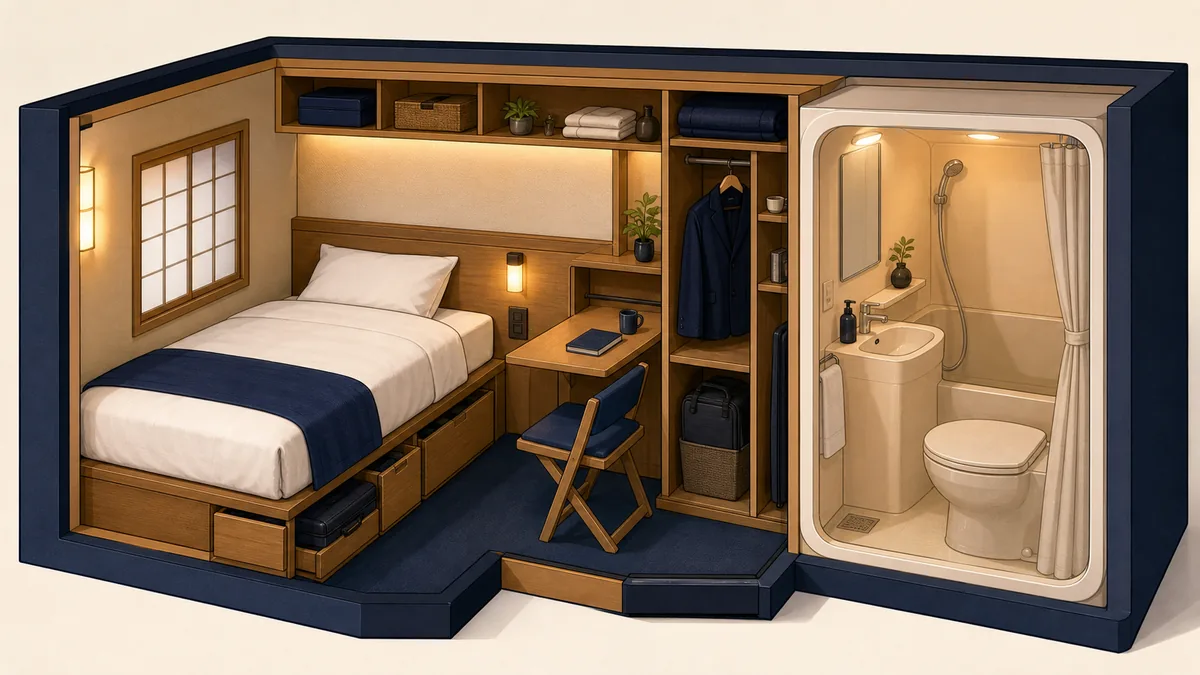
At two in the morning the lobby is quiet enough that you can hear the elevator counting floors, and every so often a guest arrives already annoyed, key card in hand, having just measured their room against the size of their carry-on. Nine times out of ten the complaint is the same: the room is smaller than it looked in the photos. What that guest usually has not done is read the floor area listed in square metres, which was sitting on the booking page the entire time. A small Japanese hotel room is not an oversight or a cash grab. It is the product of decades of land economics, cleaning logistics, and a business model built to run at full occupancy on thin margins, and once you understand the logic behind it, the size stops being a problem and becomes a detail you can plan around.
The Arithmetic Behind the Legal Minimum
Tokyo land is expensive by the square metre, and a hotel owner does not get to ignore that arithmetic just because a guest wants more legroom. Land price shapes the whole building: how many floors it can carry, how much of each floor has to go to elevators, corridors, and fire stairs, and how many rooms need to exist per floor for the numbers to work at all. Japan's own regulations set a floor under this, not a ceiling. Under the enforcement order for the Hotel Business Act, a guest room must measure at least seven square metres, or nine square metres if it contains a bed rather than futon bedding. Most business hotels build comfortably above that legal minimum, but the margin stays deliberately modest: room for a bed, a desk barely wide enough for a laptop, and a path to the window, and rarely much beyond that.
How the Business-Hotel Model Actually Works
The Japanese business hotel — a no-frills, single-room-led format aimed at the solo traveler on a tight schedule, and today largely chain-operated — is optimized around a different guest than the Western hotel industry usually designs for. One guest, one night, in early and out early, paying a fixed and modest rate that still has to cover a night auditor, a cleaning crew, and a mortgage on land that never got any cheaper. Multiply the number of rooms instead of the size of each one, keep the layout identical floor to floor, and the building runs like a machine built for volume rather than lingering. That efficiency is the reason a clean, secure, well-located room in central Tokyo can be booked for a fraction of what an equivalent postcode costs in London or New York. It is also why the footprint stays tight: floor space is the one input the operator controls directly, and it gets spent with care.
The Unit Bath, One Mould, No Mysteries
Step into almost any business hotel bathroom and you will meet the unit bath, a single molded pod holding toilet, sink, and tub-shower combination, sealed at the joints and lowered into the room as one prefabricated piece rather than tiled on site. It dates to the construction rush ahead of the 1964 Tokyo Olympics: TOTO developed the unit-bathroom method in 1963 to fit out the Hotel New Otani — 1,044 guest bathrooms — on a deadline no tiler could meet, and put the product on sale in September 1964. Prefabrication solved it: crane the unit in, connect the plumbing, move to the next floor. Six decades on, the same logic still holds, for slightly different reasons. A molded unit bath is waterproof by design, quick to disinfect between guests, and mechanically simple. Compact suits it well, because reliability, cleanability, and turnaround speed were always the design brief.
Fixed Layouts Are a Housekeeping Strategy, Not an Accident
Every identical business hotel room you have ever stayed in was identical on purpose. When housekeeping cleans dozens of rooms before the next wave of check-ins, a fixed layout means the towels, kettle, and slippers live in the same spot on every floor, the vacuum path is the same, and nobody has to relearn the room. Furniture is built in or bolted down rather than freely arranged, which frees circulation space that a loose furniture plan would eat into. It reads as a small room from the doorway. It is really a room engineered to be cleaned fast, restocked fast, and inspected fast, so the hotel can flip it inside the narrow window most properties leave between one guest's checkout and the next guest's arrival.
What a Small Room Buys You Back
A guest who fixates on square footage is usually missing what that square footage paid for instead. Business hotel rooms in Japan are, as a category, kept spotless in a way that larger budget hotels elsewhere often are not, because a small room with a fixed layout is fast and cheap to bring back up to standard between stays. Storage tends to be smarter than the room size suggests: shelves at luggage height, hangers behind the door, a rack built specifically to hold a suitcase rather than a corner where it lives on the floor. Location is usually where the real value shows up, since a compact room lets a hotel sit two minutes from a train exit at a price a larger property on the same land could never offer. None of that shows up in a listing photo. It only shows up once you are moving through the city instead of standing in the room comparing it to the one back home.
| In the room | What you get | What usually makes up for it |
|---|---|---|
| Floor space | A bed, a desk, a suitcase rack, little else | You are rarely awake in the room long enough to miss a sofa |
| Bathroom | A molded unit bath, tub and shower combined | Reliable hot water and a fast, thorough clean between guests |
| Storage | No walk-in closet | Built-in shelving and hooks placed for luggage, not a wardrobe |
| Noise and privacy | Thin walls in some older properties | A private room and door, not a shared dorm bunk |
| Price and location | A smaller footprint per room | The same rate buys minutes from a station instead of a taxi ride |
Where Your Waking Hours Actually Go
I have checked in enough overnight guests to notice the pattern: most of them are unconscious for the majority of the time they spend in the room. A Tokyo trip tends to run as a full-day itinerary, temples and department stores and train lines and izakaya, and the room's actual job is to hold a shower, a bed, and a spot to repack a bag before the next leg. Judged against that job, a compact room rarely fails anyone. It is also why capsule hotels work for as many travelers as they do: once you accept that a room is for sleeping and not for living, square metres stop mattering nearly as much as the mattress, the shower pressure, and how far the front door sits from the station.
Reading a Listing Like a Front-Desk Clerk
At two in the morning the guests who struggle are rarely the ones traveling light. It tends to be the couple with two hard-shell suitcases the size of steamer trunks, standing in a room built for one adult and a duffel bag, working out by trial and error that both cases cannot open at the same time. That is a booking problem, and it is fixable before you ever leave home. Read the floor area in square metres on the listing itself, not just the room name, since a "standard double" means very different things at different chains. Check the bed configuration too: a semi-double runs narrower than a Western double, and a twin room usually means two separate single beds rather than one large one. Then plan the luggage the way you would plan a seating chart, working out where two large suitcases will actually sit open, because a room that suits a solo traveler with a backpack can turn hostile the moment a second big case enters the equation. Most booking sites show a floor plan, or at least a photo with the bed and desk in frame, and it is worth the extra minute before you commit. If square metres are the deciding factor for your trip, it is worth comparing business hotels vs hostels vs Airbnb before comparing individual hotels within a single format.
When to Pay for a Few More Square Metres
There are trips where the compact room stops being a clever trade-off and turns into a real constraint, and it is worth naming those honestly. Two adults sharing a room for a week, rather than a single overnight, will feel every centimetre of a floor plan built for a solo one-night stay. Anyone bringing checked luggage for a family, or traveling with a stroller, is fighting the same battle as the couple with steamer trunks, just for longer. Remote workers who need an actual desk, not a shelf wide enough for a laptop and nothing else, should look specifically for that amenity rather than assume a standard business hotel room will provide it. In any of those cases, paying up for a higher room grade, a property built for longer stays, or a different neighborhood entirely is usually cheaper in patience than fighting a room built close to the legal floor for a week. Deciding where to stay in the first place makes this easier to plan around; the guide to where to stay in Tokyo is the right place to start narrowing down a neighborhood and a format before you get to individual listings.
Sources
- Japan Ministry of Health, Labour and Welfare — Hotel Business Act Enforcement Order (旅館業法施行令), Article 1, guest room minimum floor area. Article 1(1)(i) reads: 「一客室の床面積は、七平方メートル(寝台を置く客室にあつては、九平方メートル)以上であること。」 Text checked against the article on 2026-08-01.
- TOTO — "Industry-first unit bathroom turns 60" (news release, 2024-03-18): the unit-bathroom method was developed in 1963 to supply bathrooms at speed for the Hotel New Otani ahead of the 1964 Tokyo Olympics, covering 1,044 of its guest rooms.
- TOTO — "54 years since the first unit bathroom of September 1964" (news release, 2018-04-18): confirms the September 1964 launch date and the Hotel New Otani installation.